

/prod01/prodbucket01/media/durham-university/alumni-/page-header-banners/News-Banner.png)
Artificial Intelligence: how Durham researchers are preparing us for the future
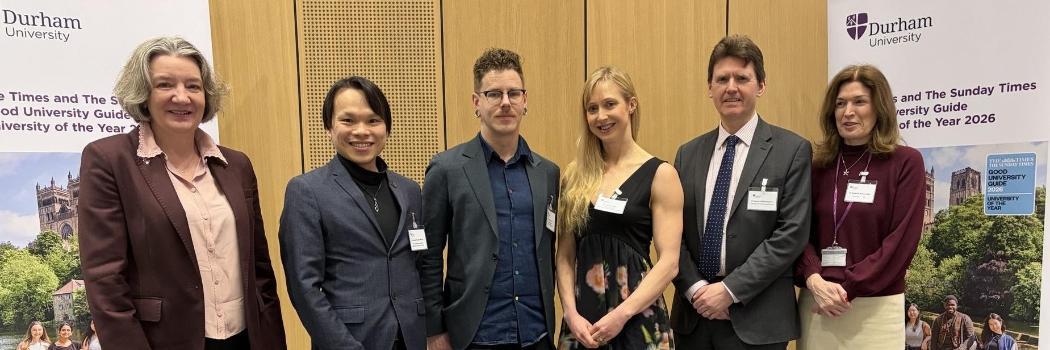
A panel of our leading academics shared how the University’s academic expertise will play a key part in unlocking the potential of Artificial Intelligence (AI), contributing to the regional and national economy and skills.
Our annual meeting of Convocation took place at Durham University Business School’s Waterside Building on Monday 23 February. An alumni audience joined our Vice-Chancellor and Warden, Professor Karen O’Brien, Deputy Vice-Chancellor and Provost, Professor Mike Shipman, and an expert panel of leading academics.
The evening opened with a panel discussion on how our research into AI is contributing to wider national and regional conversations. This was followed by the Vice-Chancellor presenting highlights of 2025.
Preparing for tomorrow’s world
Professor Mike Shipman, Deputy Vice-Chancellor and Provost, chaired the panel of academics Professor Hubert Shum, Dr Sarah Heaps, and Dr Travis LaCroix.
The panel analysed the growing role of AI in tomorrow’s world, and the need for greater consideration of human-AI interaction and control. They also explored the diverse body of interdisciplinary research conducted on AI across the University, and how our academic expertise could play a significant role in preparing us for the future.
The conversation highlighted the importance of working together to consider challenges from a whole range of perspectives, to enrich, shape, and change lives.
Questions from the audience covered a range of themes, including:
- Whether we should be polite to AI;
- Who supervises and corrects AI when it goes wrong;
- Its accuracy and reliability now that its scope covers the entirety of the internet;
- AI morality and control;
- Its impact on learning and the learning process.
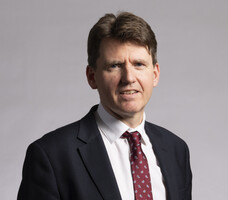
The power of artificial intelligence, its role now and in the future, and the importance of human-AI interaction was loud and clear throughout our discussion. Through our world-leading research and education and our global collaborations we are contributing to the optimisation, understanding and application of this significant and rapidly advancing technology.
Our speakers
Dr Sarah Heaps, Associate Professor, Department of Mathematical Sciences
.png) Dr Heaps is a Bayesian statistician specialising in time-series and latent variable models. Former Assistant Co‑Director of the EPSRC CDT in Cloud Computing for Big Data, she leads major grants and has delivered invited seminars worldwide, including at Duke, Columbia, and the Flatiron Institute NY.
Dr Heaps is a Bayesian statistician specialising in time-series and latent variable models. Former Assistant Co‑Director of the EPSRC CDT in Cloud Computing for Big Data, she leads major grants and has delivered invited seminars worldwide, including at Duke, Columbia, and the Flatiron Institute NY.
“The desire behind AI is to optimise data processing and performance metrics. This helps to automate tasks normally done by humans, which then augments the decision-making process, and improves lives through data driven machine learning. Real-life applications spring from learning from underlying data. Statisticians often work with other scientists to quantify uncertainties arising from modelling and data collection. For instance, I have worked with neuroscientists to analyse brain activity in those with epilepsy.”
Dr Travis LaCroix, Assistant Professor, Department of Philosophy
.png)
Dr LaCroix is a philosopher and Fellow of our Institute for Medical Humanities, faculty affiliate of the Schwartz Reisman Institute for Technology and Society, and Co‑Director of the Academic Placement and Data Analysis project. Travis’ research explores ethically-aligned AI, social norms, and the philosophy of autism within complex social systems today.
“Many of the most important problems in AI are not purely technical, but rather structural and institutional. Bias, fairness failures, and opacity often emerge from how systems are organised and incentivised—not just from flawed code. My work brings philosophy of science, social epistemology, and formal modelling together to show that responsible AI requires rethinking governance, incentives, and collective action—not just improving algorithms.”
Professor Hubert Shum, Professor of Visual Computing, Department of Computer Science
.png) Professor Shum specialises in modelling spatio-temporal visual information with responsible AI. He has published over 200 papers and led research funded by EPSRC, MoD, Royal Society and Innovate UK. His interdisciplinary research is wide ranging, and includes space technology, the arts, and healthcare.
Professor Shum specialises in modelling spatio-temporal visual information with responsible AI. He has published over 200 papers and led research funded by EPSRC, MoD, Royal Society and Innovate UK. His interdisciplinary research is wide ranging, and includes space technology, the arts, and healthcare.
“AI is everywhere. Yet AI doesn’t understand human logic, society or culture, and isn’t good at doing things it hasn’t done before. Humans are very good at improvising and finding creative solutions. It is key that humans and AI work together. At Durham we have fantastic research, for example from the Leverhulme Centre for Algorithmic Life, and the Space Research Centre, to help the UK to become a major AI power.”
The evening was hosted by our Vice-Chancellor and Warden, Professor Karen O’Brien and University Secretary, Dr Amanda Wilcox.
It was organised by Advancement teams (DARO, Marketing and Communications) under Lucian Hudson, Executive Director of Communications & External Affairs; and Event Durham.
-----
Find out more
- About our alumni community.
- About our speakers and their research:
- Read our key University publications at your leisure.
- View our current research.
Durham University takes pride in the achievements and contributions of its 230,000 alumni and supporters. Stories that cite views, talks and published work reflect the individual's contribution in their personal or professional capacity and do not represent the University's position or endorsement.
/prod01/prodbucket01/media/durham-university/alumni-/alumni-events/IMG_5839-1050X799.jpeg)
/prod01/prodbucket01/media/durham-university/alumni-/alumni-events/IMG_5842-1050X788.jpeg)