

IP, Entrepreneurship, and Innovation in Practice: Turning Research into Impact

Blog post by Mengyi Mei.
The third and final session in the Innovation and Ownership: Interdisciplinary Conversations on Intellectual Property and Research Practice series brought the project to a highly practical close. Organised by Dr Van Anh Le (Assistant Professor in IP Law), featured Michael Bath (Senior Technology Transfer Manager) as the invited speaker. The discussion was chaired by Dr Mengyi Mei (Career Development Fellow in IP Law) who also authored this blogpost. The discussion focused on the practical role of intellectual property (IP) in research commercialisation, entrepreneurship, and technology transfer.
The event drew participants from across the University, including students, researchers, and postdoctoral scholars in fields ranging from law to biosciences. This diversity underscored the growing interest in how IP supports the pathway from academic research to outputs with commercial and societal value.
Building on the earlier sessions, which explored authorship, ownership, and responsibility, this concluding discussion turned to the institutional and commercial dimensions of IP in practice. It explored how researchers move from early-stage ideas to practical applications, and how issues of ownership, licensing, collaboration, and commercial strategy shape that process both within and beyond the University.
Drawing on his extensive experience in supporting spinouts, Mike outlined the key stages of the commercialisation pathway. He highlighted the importance of early assessment of originality, market demand, barriers to entry, and defensibility of the relevant IP. These steps, he noted, are essential for shaping realistic routes to impact.
Michael also provided valuable insight into the University’s role in protecting and licensing staff-created IP, and into the legal and organisational frameworks that support spinout formation. He emphasised the practical challenges researchers face when engaging with investors, developing business plans, and assembling strong multidisciplinary teams, activities that require alignment between research goals, institutional policy, and commercial strategy.
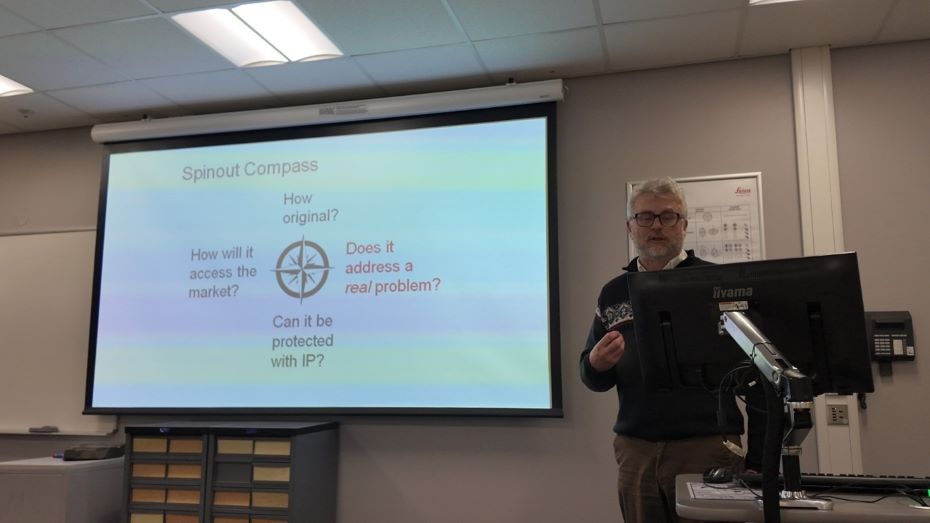
A recurring theme throughout the talk was that successful innovation depends not only on the strength of an idea, but also on management capacity, market understanding, and long-term commitment. By drawing together strategic, legal, and organisational perspectives, the session gave attendees a realistic sense of what it takes to turn research into tangible impact.
The discussion that followed Michael’s presentation further underscored the value of the session’s interdisciplinary perspective. Postdoctoral researchers working in biosciences, for example, noted the importance of gaining a clearer understanding of the patent application process, both from the practical standpoint of a Technology Transfer Manager and from the legal standpoint of patent law requirements. This combination of commercial and legal perspectives illustrated.
As the concluding event in the series, the session reaffirmed the importance of IP not only as a legal framework but also as an essential mechanism for protecting, developing, and realising the potential of university research. It brought the series to a cohesive close by highlighting the strategic role that IP plays in enabling research to generate meaningful economic and societal benefit.


This series forms part of the IP and Innovation Initiative at Durham Law School, an emerging interdisciplinary platform exploring IP, AI, innovation and research impact.