

/prod01/prodbucket01/media/durham-university/departments-/physics/teaching-labs/VT2A9034-1998X733.jpeg)
Developing Talent Award Winners 2025-2026
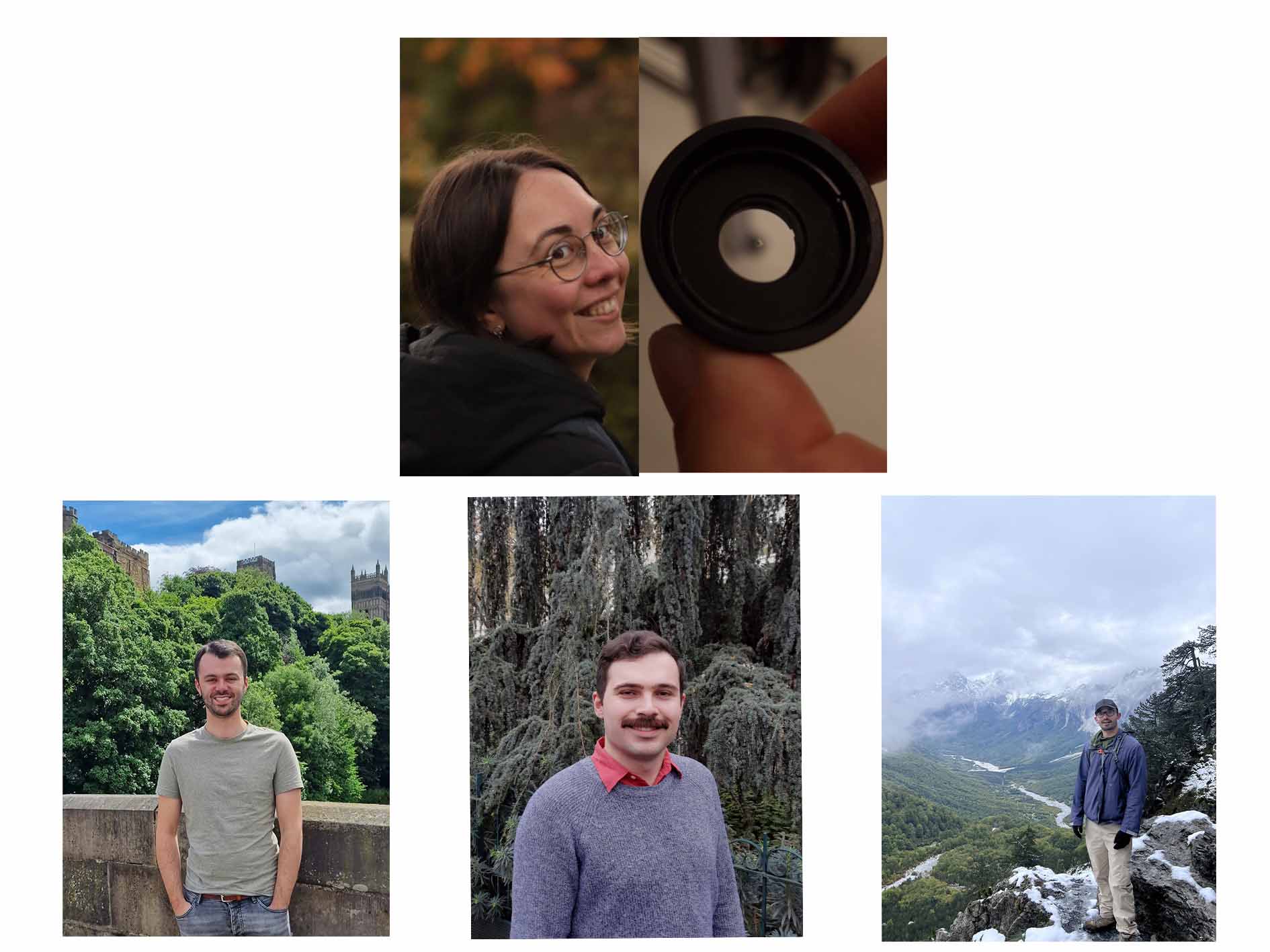
We are pleased to announce the winners of the Developing Talent Award for 2026: James Gill-Fleming (CfAI) , Aurelie Magniez (CfAI), Omer Rathore (CMP) and Max von Wietersheim-Kramsta (ICC & CEA) Summaries of their projects can be found below. Congratulations to all awardees and best of luck with your projects. We'd like to thank everyone who applied for their excellent proposals. There were 13 submissions this year. The competition was tight, and the panel had their work cut out for them.
Single-photon spectroscopy with next-generation qCMOS cameras
Many scientific experiments rely on measuring very faint light, but under extremely low light levels these signals can be lost in the background noise of conventional detectors. Single-photon counting spectroscopy offers a way around this by detecting light one photon at a time, allowing meaningful information to be recovered even when very little light is available. This project will show that this powerful approach can be achieved using a new generation of commercial quantitative CMOS (qCMOS) cameras, avoiding the need for complex and expensive cryogenic detectors.
By combining a qCMOS camera with a standard spectrometer, this project will push the Raman spectroscopy technique into the ultra-low illumination regime, enabling molecular “fingerprints” to be identified using dramatically less light than before. This makes it possible to study fragile or light-sensitive samples that would otherwise be damaged, with potential applications ranging from microscopy and astronomy to the analysis of cultural heritage objects, including fine art paintings.
Aurelie Magniez (CfAI)
Revolutionising Pyramid Wavefront Sensors with 3D-Printed, High-Precision Pyramidal Optics
Essential for modern ground-based astronomy, adaptive optics (AO) systems correct atmospheric turbulence to produce sharper telescope images. A key component of these systems is the wavefront sensor, which measures light distortions so they can be corrected. Highly sensitive, the pyramid wavefront sensor is selected for the next generation of high-contrast imaging instruments. However, these sensors rely on specialised glass prisms that are difficult to manufacture and expensive.
This project therefore proposes a new, more accessible approach: manufacturing pyramids using high-precision 3D printing. Recent advances in this technology allow optical components to be produced with extremely high accuracy and greater design flexibility than traditional glass pyramids, at a lower cost. An initial 3D-printed prototype has already been tested in a laboratory wavefront sensing system, identifying key areas for improvement. With this award, I will design and experimentally evaluate a new set of 3D-printed pyramids.
Our two main goals are to develop a pyramid suitable for integration into the new AO system at the Keck Observatory, and to exploit the unique flexibility of 3D printing to explore new concepts. Demonstrating that 3D-printed pyramids can meet the demands of advanced AO will enable more flexible and cost-effective technologies for future instruments.
Omer Rathore (CMP)
Towards Sustainable Acceleration: Quantum Annealing for Data and Physics Driven Workloads
Quantum computing is moving from theory to practical demonstrations, as new machines become powerful enough to tackle meaningful tasks. This project puts real quantum hardware to work on two classes of problems that are especially challenging for classical computers. Using quantum annealing, a practical approach available through cloud-accessible processors, the research will identify where quantum technology can deliver near-term benefits.
The first focus is fluid dynamics, the simulations behind aircraft, energy systems, and extreme events. These models are costly because they must constantly decide where to spend computing power as shocks and turbulence evolve. The project will explore quantum-assisted machine learning to make those “where to zoom in” choices smarter, aiming to maintain accuracy while reducing the time and energy needed for large simulations. The second focus is quantum chemistry, which underpins the search for better batteries, catalysts, and new materials. Many realistic chemistry calculations quickly become infeasible on classical machines. The project will investigate whether quantum annealing can help estimate key low-energy molecular properties using methods designed for today’s hardware.
By delivering clear benchmarks and practical guidance, the work aims to separate hype from reality and identify where quantum computing can accelerate discovery.
Max von Wietersheim-Kramsta (ICC & CEA)
Cosmos to Care: A Durham Sprint for Cross-Disciplinary Innovation in the Development of Cancer Treatments
Cancer care has advanced rapidly, yet choosing the right treatment for each patient remains difficult, slow, and costly. Trials can take decades to show benefits, and patients often receive several drugs with detrimental side effects because we cannot confidently predict which one will work best.
In cancer research, pre-clinical laboratory data and clinical trial data are often analysed to predict treatment outcomes in patients and extracting meaningful and interpretable predictions of the viability of certain cancer treatments can be challenging. In astronomy and cosmology, we face similar statistical challenges for which we develop Bayesian inference methods. The AI-VISION interdisciplinary collaboration between cosmologists in Durham and Newcastle, oncologists from the Institute for Cancer Research in London, and the industrial partners from concr applies advanced statistical and machine-learning methods, typically applied in cosmology, that can be used to make better predictions from existing cancer data. Improving such predictions may help to better inform and accelerate future clinical trials of new cancer treatments, while helping clinicians select more effective drugs for individual patients across the NHS and beyond.
To advance this goal, the PDDTA will facilitate the “Cosmos to Care” sprint and workshop that will be held in Durham. Experts in oncological data and cosmologists like myself will be brought together to advance existing collaborations, plan future research, and present their work to the wider community in Durham. The workshop will culminate in a public outreach event and reception to divulge the results and impacts achieved by applying the lessons learnt from astronomical research to cancer research.
A huge thank you to everyone who volunteered to be on the evaluation panel:
Claire Greenwell & Isabel Santos-Santos (Panel Co-chairs, CEA & ICC), Carlton Baugh (Director of Research), Kyle Oman (Research staff champion), Kathryn Hartley (CfAI), Matteo Marcoli (IPPP), and Dan Ruttley (CMP).
The Developing Talent Award will open again towards the end of this year for a new round of project funding. If you missed out this year and would be interested in applying for 2027, keep an eye out for the DTA 2027 announcement in early October...