

/filters:quality(70)/prod01/prodbucket01/media/durham-university/departments-/engineering/74202-5112X1676.jpg)
Vibrometry Lab
Contact: Dr Stefan Szyniszewski
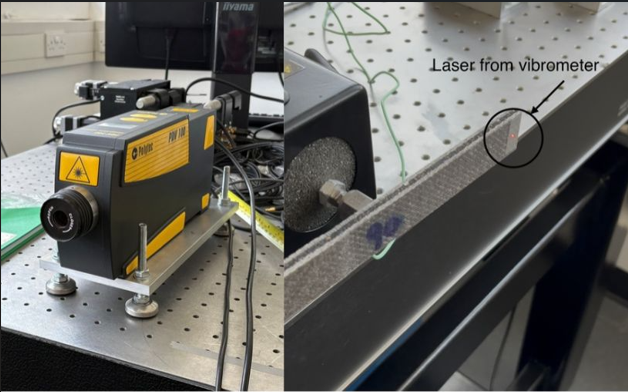
Technical Specifications
The University Vibrometry Laboratory provides facilities for non-contact vibration characterisation of materials and structures, centred on a Polytec PDV-100 laser Doppler vibrometer. The system measures surface vibration velocity using a 633 nm Class 2 helium–neon laser and offers selectable full-scale velocity ranges of 20, 100 and 500 mm/s, with measurement capability extending to 22 kHz. It provides a ±4 V analogue output and 24-bit, 48 kSa/s S/PDIF digital output, together with selectable 1, 5 and 22 kHz digital low-pass filters and a switchable 100 Hz high-pass filter. The optical system supports stand-off distances from approximately 0.1 m to 30 m, subject to target surface properties, enabling flexible non-contact measurement configurations. The laboratory test chain can incorporate shaker-and-stinger excitation, load-cell force measurement, signal generation, oscilloscope monitoring and computer-based acquisition and analysis using VibSoft; demonstrated testing includes broadband white-noise excitation and targeted sine sweeps, with FFT-based displacement/force transfer functions used to identify natural frequencies, damping ratios and loss factors.
How does it work?
The Laser Doppler Vibrometer involves directing a high-precision laser at a surface being moved by a shaker. When the surface vibrates, it causes the frequency of the reflected light to shift due to the Doppler effect. Internal sensors in the laser calculate the shift in frequency and can calculate information such as the velocity and displacement of the object when being vibrated at different frequencies, as well as the force exerted on the object.
Benefits of the method
The key benefit of this method is the large range of frequencies that can be measured across. Another is the ability for non-contact measurements of hot objects without them damaging the equipment. A further advantage is that due to the use of a laser, it is less likely that the test object will be damaged if fragile. This equipment is also highly mobile and portable, and can be arranged to be taken for use off site if a customer requires the tests to occur at their premises.
Uses
Uses of the vibrometer vary and have applications across many industries.
These include:
- Testing aerospace components for stress and fatigue
- Mapping noise, vibration, and harshness (NVH) in automotives
- Monitor vibrations of a material under stress
- Analysing vibrations in (micro-electromechanical systems) MEMS
Case Study
One example of a use within the Engineering department has been in finding the impact of calcium oxide damping inside of a Nomex honeycomb structure between two sheets of aramid fibre. The students were able to measure force and velocity against frequency for a range of volumes of calcium oxide used as damping, allowing the optimal amount to be found. This allowed the group to maximise the damping. of the material when exposed to vibrations.