


How will Emperor Penguins Respond to Changing Antarctic Ice Conditions (EPIC)?
Emperor penguins are an iconic Antarctic species and so it is surprising that the first complete map of their colony locations was only made in 2024. This snapshot gives an indication of the precarious nature of their existence, because for 8 months of the year they reside on sea ice - frozen ocean water - that fringes the Antarctic continent. Since 2016 Antarctic sea ice has set new record-lows in extent, and some penguin colonies have suffered breeding failure as a result. As Antarctica responds to a warming climate, this sea ice is likely to decline over the long-term and become more unstable, posing a significant risk to the viability of emperor penguin colonies that call it their home. Predictions have suggested over 90% of colonies will become quasi-extinct by the year 2100 as their sea ice habitat is lost.
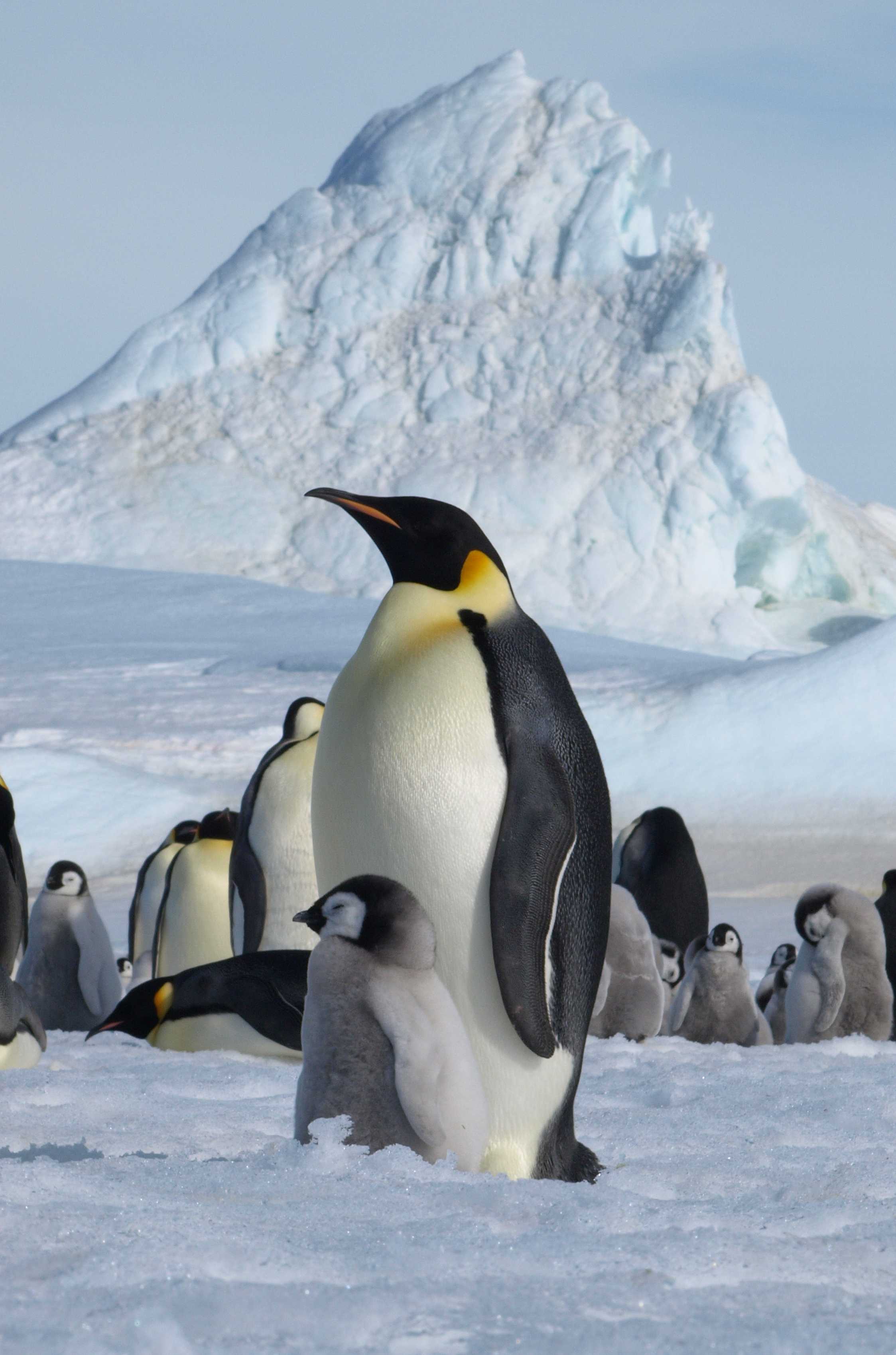
Emperor Penguins on land-fast sea ice with a nearby iceberg Image Courtesy of Peter Fretwell at British Antarctic Survey.
In addition to sea ice changes, emperor penguins are also vulnerable to calving of icebergs from glaciers and ice shelves around Antarctica. Colonies typically establish and shelter directly adjacent to the ice sheet, and therefore calving could remove or alter their preferred site. For example, new icebergs can push or fracture sea ice or cause a change in ocean circulation that leaves an embayment sea ice free. However, the impact of calving-induced sea ice breakout events on emperor penguin colonies has, until now, never been assessed. Therefore, the aim of our NERC-funded project is to assess the past, present and future vulnerability of emperor penguin colonies to changing glacier and sea ice conditions.
We are using freely-available satellite imagery to map the past locations of the emperor penguin colonies and the sea ice and glacier conditions at those locations. In doing so, we hope to answer a series of important questions about their ability to cling on to the edge of the frozen continent including: How have past sea ice and glacier margin changes impacted penguin colonies? Do colonies relocate, and if so, where to? How resilient are the colonies to sea ice disruption events? How will colonies be impacted in the future if iceberg calving increases?
Our initial work demonstrates that colonies react in a range of ways to glacier calving and changing sea ice conditions. This includes their disappearance, sometimes temporarily, their ability to split into multiple smaller colonies, and the surprise that they are found to climb up the steep ice slopes and onto the glaciers themselves more frequently than thought.
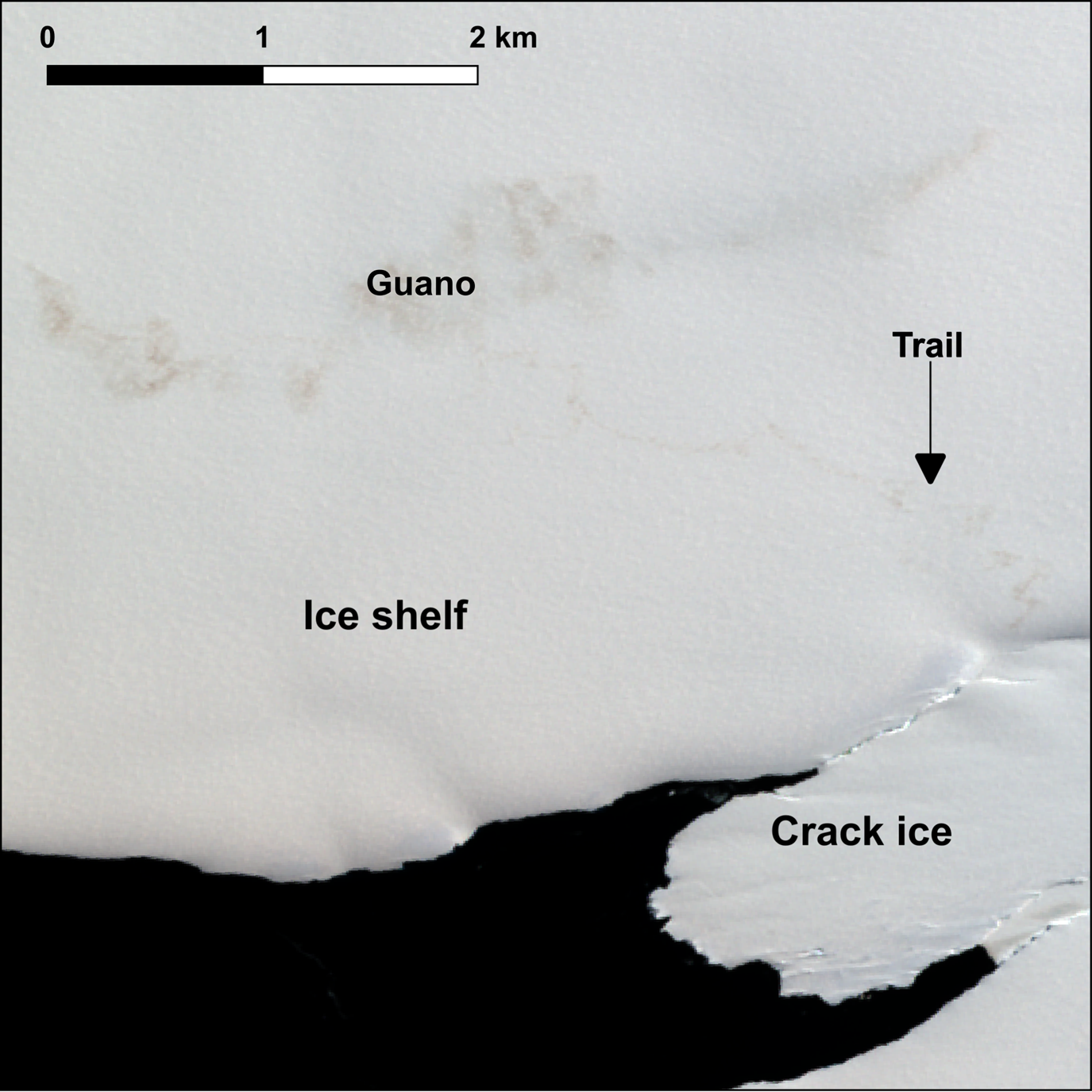
The Sanae colony’s guano is visible as a brown stain on an ice shelf showing that they climbed the glacier because the sea ice was absent. This is a Sentinel-2 image from 23rd January 2018.
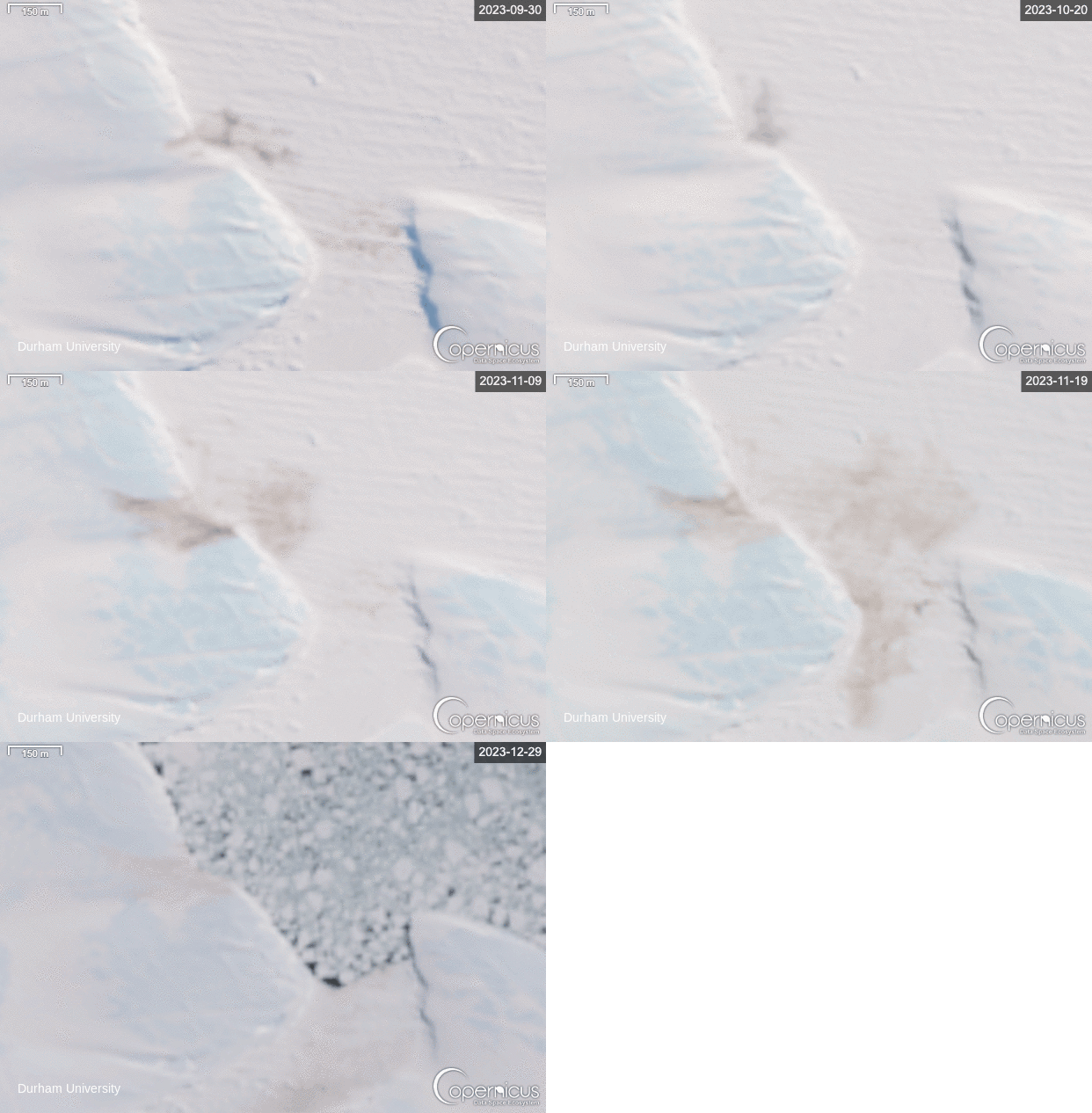
Guano stains showing the Astrid colony moving between fast ice and glacier ice before sea ice breaks out.
The EPIC project is funded by the Natural Environment Research Council (NERC) UK and is led by Stewart Jamieson with Grant Macdonald and Chris Stokes at Durham University, Peter Fretwell at British Antarctic Survey and Stephanie Jenouvrier at Woods Hole Oceanographic Institution in the USA. Work builds upon the significant satellite remote sensing efforts made at Durham to map changes in ice conditions around Antarctica.
Personal website links:
Stewart Jamieson: https://www.durham.ac.uk/staff/stewart-jamieson/ @changingice.bsky.social
Grant Macdonald: https://www.durham.ac.uk/staff/grant-j-macdonald/ @geogeordie.bsky.social
Chris Stokes: https://www.durham.ac.uk/staff/c-r-stokes/
Peter Fretwell: https://www.bas.ac.uk/profile/ptf/ @ptfretwell.bsky.social
Stephanie Jenouvrier: https://www.whoi.edu/profile/sjenouvrier/

Impacting the World
Our research across human and physical geography addresses pressing global challenges through projects focused on delivering social and environmental benefits.

Virtual Library
Much of our research takes final form in high-impact articles or books. But a considerable amount of our activity takes place in other mediums.

Postgraduate Study
Postgraduate study at Durham helps you to develop a range of high-level research, analytic, and communication skills that are transferable to multiple career paths. Our postgraduates are highly valued employees in government, third sector and private agencies, as well as academia.
Contact Us
Founded in 1928, the Department of Geography at Durham University is one of the leading centres of geographical research and education in the world.
Department of Geography
Postgraduate Study
Durham University
Lower Mountjoy
South Road, Durham
DH1 3LE, UK
Tel: +44 (0)191 33418000
Be social. Be informed. Be a part of Durham Geography.


