


Previous Temple Chevallier Lectures:
The Temple Chevallier series of occasional public lectures honours a remarkable Victorian clergyman, astronomer, and mathematician of international repute who, amongst many things, co-founded and taught Britain’s first course for civil engineers.
2026/7: 'Astronomy, God, and the search for elegance'
Took place on Wednesday 14 October 2026, Appleby Lecture Theatre (room W103) at 4.30pm
Watch the video of the lecture below
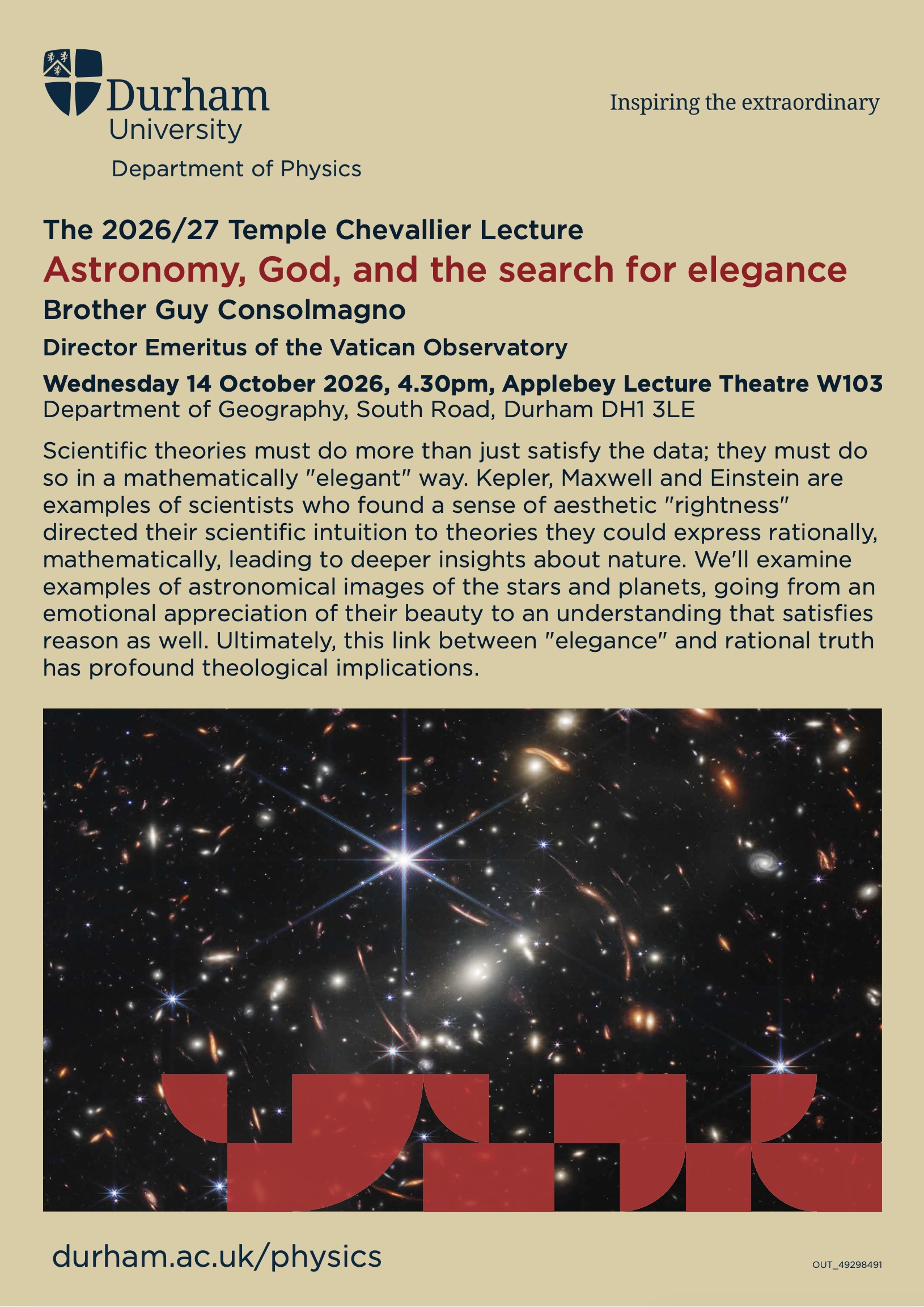
The 2026/7 Temple Chevallier lecture took place on Wednesday 14 October in the Appleby Lecture Theatre (room W103) at 4.30pm. The lecture was titled 'Astronomy, God, and the search for elegance'. Scientific theories must do more than just satisfy the data; they must do so in a mathematically "elegant" way. Kepler, Maxwell and Einstein are examples of scientists who found a sense of aesthetic "rightness" directed their scientific intuition to theories they could express rationally, mathematically, leading to deeper insights about nature. We'll examine examples of astronomical images of the stars and planets, going from an emotional appreciation of their beauty to an understanding that satisfies reason as well. Ultimately, this link between "elegance" and rational truth has profound theological implications.
Delivering the lecture was Brother Guy Consolmagno, Director Emeritus of the Vatican Observatory.
About the speaker
Br. Guy Consolmagno SJ was born in 1952 in Detroit, Michigan. He obtained his Bachelor of Science in 1974 and Master of Science in 1975 in Earth and Planetary Sciences from the Massachusetts Institute of Technology, and his Ph.D. in Planetary Science from the University of Arizona in 1978. From 1978-80 he was a postdoctoral fellow and lecturer at the Harvard College Observatory, and from 1980-1983 continued as postdoc and lecturer at MIT.
In 1983 he left MIT to join the US Peace Corps, where he served for two years in Kenya teaching physics and astronomy. Upon his return to the US in 1985 he became an assistant professor of physics at Lafayette College, in Easton, Pennsylvania, where he taught until his entry into the Jesuit order in 1989. He took vows as a Jesuit brother in 1991, and studied philosophy and theology at Loyola University Chicago, and physics at the University of Chicago before his assignment to the Vatican Observatory in 1993.
In spring 2000 he held the MacLean Chair for Visiting Jesuit Scholars at St. Joseph’s University, Philadelphia, in 2006-2007 the Loyola Chair at Fordham University, New York, and in fall 2009 the Lanigan Chair in Science, Medicine, and Ethics at LeMoyne College, Syracuse. He has also been a visiting scientist at the Goddard Space Flight Center and a visiting professor at Loyola College, Baltimore, and Loyola University, Chicago.
Br. Consolmagno has served on the governing boards of the Meteoritical Society; the International Astronomical Union’s (IAU) Division III, Planetary Systems Science (secretary, 2000 – present) and Commission 16, Moons and Planets (president, 2003-2006); and the American Astronomical Society Division for Planetary Sciences (chair, 2006-2007). Since 2008 he has been a member of the IAU Working Group on Planetary System Nomenclature and the Mars Nomenclature Task Group; in 2015 he became chair of the Mars TG.
He has coauthored two astronomy books: Turn Left at Orion (with Dan M. Davis; Cambridge University Press, 1989) and Worlds Apart (with Martha W. Schaefer; Prentice Hall, 1993). He is the author or co-author of four books exploring faith and science issues, including The Way to the Dwelling of Light (U of Notre Dame Press, 1998); Brother Astronomer (McGraw Hill, 2000); God’s Mechanics (Jossey-Bass, 2007), and Would You Baptize an Extraterrestrial? (With Paul Mueller, Image, 2014). He also edited The Heavens Proclaim (Vatican Observatory Publications, 2009). Since 2004 he has written a monthly column on astronomy for the British Catholic periodical, The Tablet./p>
He is interested in science public outreach, and has been a guest on Patrick Moore’s “The Sky at Night”, and Melvyn Bragg’s “In Our Time”.
Br. Consolmagno’s research explores the connections between meteorites and asteroids, and the origin and evolution of small bodies in the solar system. In 1996, he spent six weeks collecting meteorites with an NSF-sponsored team on the blue ice of Antarctica, and in 2000 he was honored by the IAU for his contributions to the study of meteorites and asteroids with the naming of asteroid 4597 Consolmagno.
2023: 'The End is Not Yet Nigh: The Ultimate Fate of the Universe'
Took place on Wednesday 15 November, Appleby Lecture Theatre (room W103) at 4.30pm
Watch the video of the lecture below

The 2023 Temple Chevallier lecture took place on Wednesday 15 November in the Appleby Lecture Theatre (room W103) at 4.30pm. The lecture was titled 'The End is Not Yet Nigh: The Ultimate Fate of the Universe' and covered some concepts from major religions, and the modern cosmologists' latest theories of how all things might end.
Delivering the lecture was Professor Martin Ward, Emeritus Temple Chevallier Professor of Astronomy in the Department of Physics here at Durham.
About the speaker
Prof Martin Ward is currently the Temple Chevallier Chair of Astronomy. He has previously held positions at Cambridge, Oxford and Leicester, before coming to Durham in 2004.
He is an observational astrophysicist whose research interests include black holes and quasars. He was a consultant for the European Space Agency and is involved in the next generation Hubble Telescope project.
He is interested in science public outreach, and has been a guest on Patrick Moore’s “The Sky at Night”, and Melvyn Bragg’s “In Our Time”.
| Name of Lecturer | Institution at time of lecture | Title of Lecture | |
|---|---|---|---|
| 2009 | Rt Rev Dr Tom Butler | Bishop of Southwark | God and Science, Pure and Applied? |
| 2005 | Dr David Wilkinson | Durham University | Proofs of the divine power? |
| 2001 | Dr Robert Hawley | University of Durham | The Journey: from science via engineering to technology |
| 1996 | Sir Arnold Wolfendale, FRS | University of Durham | Life beyond the earth and life after the earth's demise? |
| 1991 | Professor Geza Vermes | The Oriental Institute, Oxford | The Dead Sea scrolls: a new era in biblical and Jewish studies |
| 1990 | Sir Micheal Atiyah, FRS | University of Oxford | New ideas in Geometry and Physics |
| 1989 | Dr John Habgood | Archbishop of York | The scientist as priest |