

Staff profile
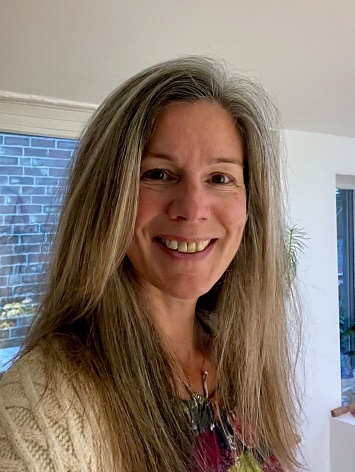
| Affiliation |
|---|
| Professor in the Department of Anthropology |
Biography
I am a primatologist and biological anthropologist with research interests spanning primate behavioural and evolutionary ecology, conservation, human–primate relationships, and research ethics and practice. I have conducted primate field research since 1996, particularly in Gabon, and have extensive experience of primate research and conservation globally.
I joined Durham Anthropology in 2007. I have a PhD in Zoology from the University of Cambridge and moved into Anthropology through postdoctoral positions at Roehampton University and the University of Cambridge, followed by a lectureship at University College London.
I teach biological and evolutionary anthropology at undergraduate and postgraduate levels and have won two awards for doctoral supervision. I have held a range of leadership roles at Durham, including Director of Research and Director of Postgraduate Research.
My preferred name is Jo. My pronouns are she/her/hers.
Research
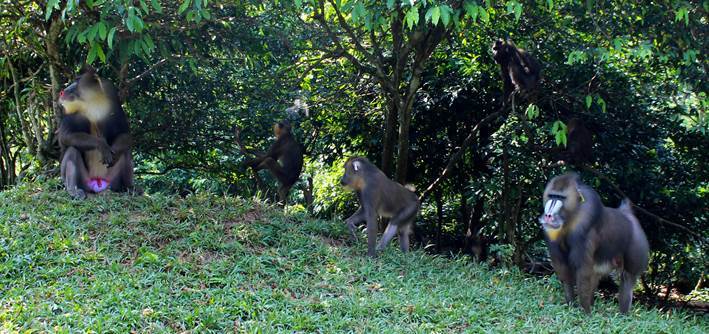
My research spans primate behavioural and evolutionary ecology, human-primate relationships and conservation, and research ethics and practice. Across these areas, I draw on three decades of field experience and interdisciplinary collaboration.
Primate behavioural and evolutionary ecology
My research in primate behavioural and evolutionary ecology focuses on sexual selection, signalling, reproductive strategies and life history.
Mandrills (Mandrillus sphinx) have been central to my research since 1996. My long-term collaborative research in Gabon has combined behavioural observations with morphology, demography, endocrinology, genetics, chemical ecology, dental histology and microbiology to investigate these questions.
For more about our long-term studies of mandrills, please see my mandrill research pages and this review.
Human–primate relationships and conservation
My long-term experience in Gabon and other primate range countries has given me extensive experience of conservation challenges and primate reintroductions. These experiences have convinced me that conservation must be grounded in a thorough understanding of historical, political and social contexts. In other words, social science approaches are essential to conservation.
My collaborators and I have detailed our interdisciplinary approach to conservation here and here.
Research practice, ethics, and equity
I also work on how primate research itself is conducted, with interests in research ethics, methodological rigour, transparency, equitable research partnerships, responsible communication about primates, and improving practices for the capture and release of wild primates.
These interests inform my work as Editor-in-Chief of the International Journal of Primatology and my book Studying Primates: How to Design, Conduct and Report Primatological Research.
I co-moderate a private room on WildHub on 'Primate Capture, Release and Alternatives'. The room is a project of the International Primatological Society's Committee to Make the Capture and Release of Wild Primates Safer and Find Alternatives. It is a place to share best practices for capture, discuss alternatives to capture, seek help with planning captures, and discuss challenges encountered when capturing and releasing wild primates. If you're interested in joining, please email me.
You can find details of my publications below and on Researchgate.
Studying Primates: How to Design, Conduct and Report Primatological Research
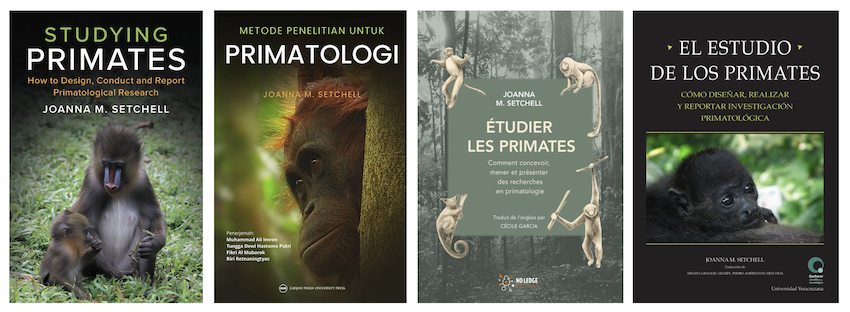
Motivated by my experience as Editor-in-Chief of the International Journal of Primatology, an understanding that not everyone has access to expert mentoring, and the need for evidence in primate conservation, I wrote a guide that explains how to develop a research question in primatology, formulate testable hypotheses and predictions, design and conduct a project, and report the results. I focus on research integrity and ethics throughout, and provide practical advice on overcoming common difficulties researchers face.
The book is designed for graduate students, postdoctoral researchers, and those teaching primatology. My aim is that it should be on the bookshelf of every primatologist, primate research station, and primate sanctuary. All royalties go to primate conservation.
English: Setchell JM. 2019. Studying Primates: How to Design, Conduct and Report Primatological Research. Cambridge University Press. I welcome feedback if you're using this. Royalties go to the International Primatological Society's conservation fund. The full text is freely available on ResearchGate.
French: Setchell JM. 2024. Étudier les primates: Comment concevoir, mener et présenter des recherches en primatologie. NoLedge Editions. Translated by Dr Cécile Garcia. Royalties go to the Société Francophone de Primatologie.
Indonesian: Setchell JM. 2024. Metode Penelitian Untuk Primatologi. UGM Press.
Spanish: Setchell JM. 2026. El estudio de los primates: Cómo diseñar, realizar y reportar investigación primatológica. Translated by Dr Pedro Américo D. Dias and Dr Ariadna Rangel-Negrín. Universidad Veracruzana.
Portuguese: A Portuguese translation (Estudando primatas : Como conceber, conduzir e comunicar pesquisas na primatologia) is underway.
If you are interested in translating Studying Primates into another language, I am very keen to hear from you.
Featured research and resources
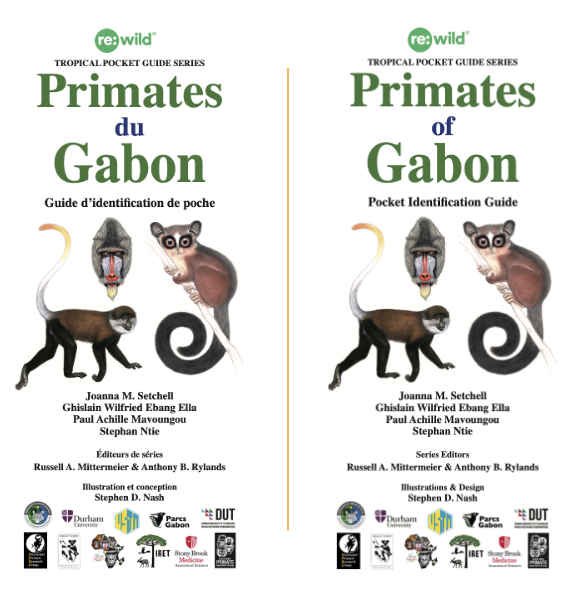
- Pocket Guide to the Primates of Gabon, in French and English.
- A recent editorial on Promoting Equitable Research Partnerships in Primatology explores how primatologists can collaborate more equitably and examines some of the challenges involved.
- This article, based on Miles Woodruff’s PhD research, tests the common assumption that release into the wild is beneficial for orphaned primates. We show that a carefully planned release of mandrills can promote their wellbeing. Watch here to find out more.
- Primates are facing an impending extinction crisis - but we know very little about what will actually protect them.
- Best Practice Guidelines for Responsible Images of Non-Human Primates. Available in 23 languages.
Professional leadership and recognition
- Lifetime Achievement Award, African Primatological Society, September 2026.
- Editor-in-Chief, International Journal of Primatology since 2009. As Editor-in-Chief, I have worked to improve research and publishing practice in primatology, with particular attention to equity and inclusion, research ethics, transparency and methodological rigour. There's more detail in this blog piece.
- Sub-panel member for Anthropology and Development Studies, UK Research Excellence Framework 2021 and 2029.
- President, Primate Society of Great Britain 2018-2021.
- Vice-President (Research) of the International Primatological Society 2010-2018.
- Member, IUCN Primate Specialist Group, Section for Human-Primate Interactions.
- Editorial Board member, Scientific Data, since 2016.
- Associate Editor, Journal of the Royal Anthropological Society. August 2024 to May 2026.
- Member, Equity, Diversity, Ethics and Inclusion Committee of the International Primatological Society.
- Member, Equity, Diversity, and Inclusion Committee of the European Federation of Primatology.
Public engagement
I enjoy public engagement, including public talks, and appearances on BBC Radio 4's The Infinite Monkey Cage, France 24, the Mammalwatching podcast, Science Shambles, BBC4's The Secrets of Skin, and Colour: The Spectrum of Science, BBC2's Nature’s Weirdest Events, and WaterBear's Not a Pet: Primates.
Here's the English version of a short documentary about a trip to Bioko, Equatorial Guinea, broadcast on Czech Television, with thanks to Lukas Zeman, Lucy Zemanova, Justin Jay, Laura Simó and the Drill Project.
Recorded presentations
- A recording from the Société Francophone de Primatologie Colloque 2021 Why conservation needs anthropology (in French).
- A recording of my Presidential Plenary at the Primate Society of Great Britain Winter meeting 2020 on 'Decolonising Primatology' (in English).
- A recording from an IUCN Primate Specialist Group Section for Human-Primate Interactions webinar on Decolonising Primate Conservation.
Information for prospective students and postdocs

If you're interested in doing a Masters by Research or a PhD, you will need funding to cover fees, living costs and research costs. PhDs in the UK do not include a taught component and are usually 3-4 years if you study full-time.
I do not have funding for PhD students unless you can see a specific advert on this page. Options for PhD funding through Durham University include our Doctoral Training partnerships, and other scholarships. Deadlines are usually in January and early preparation with multiple rounds of feedback is essential for a chance of success. This database might also be useful.
There's information about a variety of postdoctoral fellowship opportunities here. Again, early preparation with multiple rounds of feedback is essential for success. Durham University often has internal deadlines ahead of funding deadlines, to facilitate peer review.
I prioritise applications from range-country primatologists, and those which relate to and build on my own research interests. I am particularly keen to work with qualitative social scientists interested in human-primate interactions and biodiversity conservation.
Former postdoctoral researchers
- Dr Sarah Maya Rosen, ESRC post-doctoral fellowship Intersectional Forensic Anthropology: Shifting Our Methodological Paradigm (2022-2023). In addition to being an anthropologist, Sarah is also an artist and a poet and writes short stories.
- Dr Sharon Kessler: Marie Skłodowska-Curie fellowship on disease recognition in primates (2017-2018). Sharon is now a lecturer at Stirling University.
- Dr Rodrigo Moro-Rios: Ciência sem Fronteiras fellowship on the evolution of cooperative breeding in callitrichids. Rodrigo is now an Honorary Researcher in Anthropology at Durham.
- Dr Esther Clarke: COFUND Junior Research Fellowship Primate vocalisations as sexual signals. Esther is now a researcher in Linguistics and Philosophy at MIT, working on primate vocal communication.
- Dr Stefano Vaglio: Marie Curie Intra-European Fellowships for Career Development Primate Olfaction. Stefano is now Reader in Animal Behaviour at the University of Wolverhampton.
Current Research Students
- Christopher Miller. 'Welfare assessment of rhesus macaques: from field observation to computational models of brain network'. BBSRC-funded PhD candidate in collaboration with Dr Colline Poirier (Newcastle University). Corrections submitted.
- Dan Lewis. 'Mandrills and microbes: The role of the skin microbiome in primate communication'. IAPETUS2 DTP NERC-funded PhD candidate in collaboration with Dr Leena Kerr (Heriot-Watt University), Dr Sharon Kessler (University of Stirling), and Dr Barthélemy Ngoubangoye (CIRMF, Gabon). Corrections submitted.
- Evelyn Anca. Human-primate entanglements: Understanding Shipibo-primate relations in a changing Amazon. AHRC-funded PhD candidate in collaboration with Dr Paolo Fortis.
Completed Research Students
- Ingrid Grueso-Dominguez: 'Evaluating methods in Dental Anthropology to study biological affinities in Medieval Iberian Populations'. PhD. Passed March 2023.
- Milena Carstens. 'Time is TikToking: User perceptions of primate videos on one of the fastest growing social media platforms'. MSc by Research. Passed Nov 2022.
- Katharine Flach: 'The effect of group composition on maternal reproductive success in cooperatively breeding golden lion tamarins (Leontopithecus rosalia) and Goeldi’s monkeys (Callimico goeldii) in European zoos.' MSc by Research. Passed April 2020. Katharine is now a Biodiversity Data Officer at the Thames Valley Environmental Records Centre.
- Danson K Mwangi "Multi-species entanglement: Human-baboon interactions in Nthongoni, eastern Kenya" PhD funded by a Durham Doctoral Scholarship. Passed January 2020. Danson is now Acting Director of Capacity Building, Partnerships and Grants Management at the Kenya Institute of Primate Research.
- Pedro Mendez-Carvajal: 'A long term monitoring study to evaluate the primate conservation status in Panama using species distribution modelling and complementary information'. PhD funded by a Panamanian Government Scholarship. Passed December 2019. Pedro is Founder and Principal Investigator of Fundación Pro-Conservación de los Primates Panameños, an NGO dedicated to the study and conservation of nonhuman primates in Panama.
- Miles Woodruff: 'Glucocorticoid Metabolites and GPS Radio Collar Telemetry in Wildlife Conservation: The Jane Goodall Institute Mandrill Release Project in the Republic of Congo'. PhD in collaboration with the Jane Goodall Institute. Passed July 2019. Miles is now Interim Executive Director of Southern Nevada Conservancy.
- Steffanie Henkel: 'Group recognition via olfactory cues in rhesus macaques (Macaca mulatta) and chimpanzees (Pan troglodytes)'. University of Leipzig (external supervisor). Passed May 2019. Steffi is now a Postdoctoral Researcher at the German Centre for Integrative Biodiversity Research (iDiv) and Helmholtz Centre for Environmental Research (UFZ), Leipzig.
- Marie-Claire Pagano: "How do male interactions with infants affect mothers and infants in Barbary macaques (Macaca sylvanus)?" MSc by Research. Passed Feb 2018. Marie-Claire went on to do a PhD at Newcastle University.
- Simone Lemmers: 'Stress, life history, and dental development: a histological study of mandrills (Mandrillus sphinx)'. PhD funded by a Leverhulme Project grant. Passed April 2018. Simone went on to do a post-doc at the Cyprus Institute, Science and Technology in Archaeology Research Center, Nicosia, a research fellowship at Harvard Medical School, Boston, USA, and is now a Marie Skłodowska-Curie Research Fellow at Elettra Sincrotrone Trieste, Italy.
- Pete Tomlin: 'Juvenile primates in the context of their social group: a case study of chacma baboons (Papio ursinus) in an afro-montane environment'. PhD funded by a Leverhulme Study Abroad grant. Passed June 2016. Pete went on to do a post-doc at Mondika Gorilla Research Center, Republic of Congo, then a postdoc at Sun Yat-sen University, Guangzhou, China.
- Sian Waters: 'Population Status, Ecology and Conservation of Barbary macaques in the Rif Mountains, Morocco'. PhD funded by the Zoological Society of Edinburgh. Passed December 2014. Sian is director of the NGO Barbary Macaque Awareness and Conservation.
- Kathryn Shutt: 'An interdisciplinary risk assessment of gorilla ecotourism'. PhD funded by a NERC-ESRC interdisciplinary studentship. Passed January 2014. Kat went on to be Programme Manager for Liberia at Flora & Flauna International, then to work for the UN Environment World Conservation Monitoring Cetnre, Cambridge.
- Caroline Howlett: 'The 2D:4D ratio & social behaviour in female chacma baboons'. MSc by Research. Passed May 2013. Caroline went on to do her PhD at the University of Kent, and is now a lecturer at the University of Essex.
- Ben Coleman: 'Predator-prey interactions and vigilance landscapes in samango monkeys in South Africa'. PhD. Passed April 2013. Ben is now Development Manager, Impact & Partnerships at Keele University.
- Emilie Fairet: 'Human-wildlife conflict and its implications for the management of protected areas: A case study in Loango National Park, Gabon'. PhD funded by a Durham Doctoral Scholarship. Passed December 2012. Emilie went on to work for SFM Safari Gabon, developing eco-tourism projects, then as Programme Coordinator for the Wildlife Conservation Society in the Republic of Congo.
Research interests
- Equity
- Biosocial conservation
- Ethnoprimatology
- Human-wildlife interactions
- Primate conservation
- Primate socioecology
- Primate behavioural ecology
- Primate evolutionary ecology
- Primate socioendocrinology
- Sexual selection
- Reproductive strategies
- Life history strategies and phenotypic plasticity
Esteem Indicators
- 2025 - 2029: UK Research Excellence Framework 2029 Sub-Panel Member for Anthropology and Development Studies:
- 2024: Associate Editor, Journal of Royal Anthropological Institute:
- 2021 - 2021: UK Research Excellence Framework 2021 Sub-Panel Member for Anthropology and Development Studies: UK Research Excellence Framework 2021 Sub-Panel Member for Anthropology and Development Studies.
- 2018 - 2021: President, Primate Society of Great Britain:
- 2010 - 2018: Vice-President (Research) of the International Primatological Society: Vice-President (Research) of the International Primatological Society, two terms
- 2009: Editor-in-Chief, International Journal of Primatology: Editor-in-Chief, International Journal of Primatology, since 2009
- Editorial Board member, Scientific Data:
Publications
Authored book
- El estudio de los primates: Cómo diseñar, realizar y reportar investigación primatológicaSetchell, J. M. (2026). El estudio de los primates: Cómo diseñar, realizar y reportar investigación primatológica. Universidad Veracruz. https://doi.org/10.25009/uv.9735861
- Étudier les primates: Comment concevoir, mener et présenter des recherches en primatologieSetchell, J. (2024). Étudier les primates: Comment concevoir, mener et présenter des recherches en primatologie. NoLedge.
- Studying Primates: How to Design, Conduct and Report Primatological ResearchSetchell, J. (2019). Studying Primates: How to Design, Conduct and Report Primatological Research. Cambridge University Press.
Book review
- Brice Lefaux and Jean Wollenschneider. Sauvons les Primates. Belin, HumensisParis (2021), 364 pages, ISBN 978-2-410-02256-8Setchell, J. (2022). Brice Lefaux and Jean Wollenschneider. Sauvons les Primates. Belin, HumensisParis (2021), 364 pages, ISBN 978-2-410-02256-8. Revue de Primatologie, 13. https://doi.org/10.4000/primatologie.14334
- John Knight. Herding monkeys to paradise: how macaque troops are managed for tourism in Japan. xvi, 628 pp., figs, illus., bibliogr. Leiden, Boston: Brill, 2011. £132.00 (paper)Setchell, J. (2016). John Knight. Herding monkeys to paradise: how macaque troops are managed for tourism in Japan. xvi, 628 pp., figs, illus., bibliogr. Leiden, Boston: Brill, 2011. £132.00 (paper). Journal of the Royal Anthropological Institute, 22(1), 247-248. https://doi.org/10.1111/1467-9655.12376
Chapter in book
- Lee, Phyllis CSetchell, J. (2017). Lee, Phyllis C. In A. Fuentes (Ed.), The international encyclopedia of primatology. John Wiley and Sons. https://doi.org/10.1002/9781119179313.wbprim0032
- International Journal of PrimatologySetchell, J. (2017). International Journal of Primatology. In A. Fuentes (Ed.), The international encyclopedia of primatology. John Wiley and Sons. https://doi.org/10.1002/9781119179313.wbprim0196
- Drills and mandrillsSetchell, J. (2017). Drills and mandrills. In A. Fuentes (Ed.), The international encyclopedia of primatology. John Wiley and Sons. https://doi.org/10.1002/9781119179313.wbprim0195
- Color in competition contexts in non-human animalsSetchell, J. (2015). Color in competition contexts in non-human animals. In A. Elliot, M. Fairchild, & A. Franklin (Eds.), Handbook of color psychology. (pp. 546-567). Cambridge University Press.
- Alternative reproductive tactics in primatesSetchell, J. (2008). Alternative reproductive tactics in primates. In R. Oliveira, M. Taborsky, & H. Brockmann (Eds.), Alternative reproductive tactics : an integrative approach. (pp. 373-398). Cambridge University Press.
- Development and sexual selection in primatesSetchell, J., & Lee, P. (2004). Development and sexual selection in primates. In P. Kappeler & C. van Schaik (Eds.), Sexual selection in primates : new and comparative perspectives. (pp. 175-195). Cambridge University Press.
- Selection in relation to sex in primatesSetchell, J., & Kappeler, P. (2003). Selection in relation to sex in primates (P. Slater, J. Rosenblatt, C. Snowdon, T. Roper, & M. Naguib, Eds.; pp. 87-173). Elsevier. https://doi.org/10.1016/s0065-3454%2803%2933003-7
- Behaviour and Reproduction.Dixson, A., Harvey, N., Patton, M., & Setchell, J. (2003). Behaviour and Reproduction. In W. Holt, A. Pickard, J. Rodger, & D. Wildt (Eds.), Reproductive Science and Integrated Conservation. Cambridge University Press.
- The evolution of alternative reproductive morphs in male primates.Setchell, J. (2003). The evolution of alternative reproductive morphs in male primates. In C. Jones (Ed.), Sexual Selection and Reproductive Competition in Primates: New Perspectives and Directions. (pp. 410-435). American Society of Primatologists Special Topics in Primatology.
Edited book
- Field and Laboratory Methods in Primatology: A Practical GuideSetchell, J., & Curtis, D. (Eds.). (2011). Field and Laboratory Methods in Primatology: A Practical Guide. Cambridge University Press.
- Field and Laboratory Methods for Primatologists: A Practical Guide.Setchell, J., & Curtis, D. (Eds.). (2003). Field and Laboratory Methods for Primatologists: A Practical Guide. Cambridge University Press.
Journal Article
- Promoting Equitable Research Partnerships in PrimatologySetchell, J. M., Bicca-Marques, J. C., Guo, S., Robinson, C. A. J., Kessler, S. E., Mekonnen, A., & Razafindratsima, O. H. (2025). Promoting Equitable Research Partnerships in Primatology. International Journal of Primatology, 46, 285-303. https://doi.org/10.1007/s10764-024-00463-1
- Tropical field stations yield high conservation return on investmentEppley, T. M., Reuter, K. E., Sefczek, T. M., Tinsman, J., Santini, L., Hoeks, S., Andriantsaralaza, S., Shanee, S., Di Fiore, A., Setchell, J. M., Strier, K. B., Abanyam, P. A., Mutalib, A. H. A., Abwe, E., Chapman, C. A., Ahmed, T., Ancrenaz, M., Andriantsimanarilafy, R. R., Ang, A., … Mittermeier, R. A. (2024). Tropical field stations yield high conservation return on investment. Conservation Letters, 17(2), Article e13007. https://doi.org/10.1111/conl.13007
- Antibacterial and antioxidant activities of plants consumed by western lowland gorilla (Gorilla gorilla gorilla) in GabonYinda, L. E. D. O., Onanga, R., Obiang, C. S., Begouabe, H., Akomo-Okoue, E. F., Obame-Nkoghe, J., Mitola, R., Ondo, J., Atome, G. N., Engonga, L. O., Ibrahim, Setchell, J. M., & Godreuil, S. (2024). Antibacterial and antioxidant activities of plants consumed by western lowland gorilla (Gorilla gorilla gorilla) in Gabon. PLOS ONE, 19(9), Article e0306957. https://doi.org/10.1371/journal.pone.0306957
- News and Perspectives: Words matter in primatologyBezanson, M., Cortés-Ortiz, L., Bicca-Marques, J. C., Boonratana, R., Carvalho, S., Cords, M., de la Torre, S., Hobaiter, C., Humle, T., Izar, P., Lynch, J. W., Matsuzawa, T., Setchell, J. M., Zikusoka, G. K., & Strier, K. B. (2024). News and Perspectives: Words matter in primatology. Primates, 65, 33–39. https://doi.org/10.1007/s10329-023-01104-6
- Successful acclimatization of mandrills (Mandrillus sphinx) translocated to Conkouati-Douli National Park, Republic of Congo, as measured by fecal glucocorticoid metabolitesWoodruff, M. C., Atencia, R., Cox, D., Woodruff, G. T., Wheaton, C. J., Lavin, S. R., & Setchell, J. M. (2023). Successful acclimatization of mandrills (Mandrillus sphinx) translocated to Conkouati-Douli National Park, Republic of Congo, as measured by fecal glucocorticoid metabolites. Conservation Physiology, 11(1), Article coad025. https://doi.org/10.1093/conphys/coad025
- Mental health and well‐being in primatology: Breaking the taboosSetchell, J. M., Unwin, S., & Cheyne, S. M. (2023). Mental health and well‐being in primatology: Breaking the taboos. Evolutionary Anthropology: Issues, News, and Reviews, 32(3), 144-153. https://doi.org/10.1002/evan.21984
- Identification of potentially zoonotic parasites in captive orangutans and semi-captive mandrills: phylogeny and morphological comparisonNosková, E., Modrý, D., Baláž, V., Červená, B., Jirků-Pomajbíková, K., Zechmeisterová, K., Leowski, C., Petrželková, K. J., Pšenková, I., Vodička, R., Kessler, S. E., Ngoubangoye, B., Setchell, J. M., & Pafčo, B. (2023). Identification of potentially zoonotic parasites in captive orangutans and semi-captive mandrills: phylogeny and morphological comparison. American Journal of Primatology, 85(4), Article e23475. https://doi.org/10.1002/ajp.23475
- Decolonising Primate Conservation Practice: A Case Study from North MoroccoWaters, S., El Harrad, A., Bell, S., & Setchell, J. M. (2022). Decolonising Primate Conservation Practice: A Case Study from North Morocco. International Journal of Primatology, 43(6), 1046-1066. https://doi.org/10.1007/s10764-021-00228-0
- Chemical cues of identity and reproductive status in Japanese macaquesRigaill, L., Vaglio, S., Setchell, J. M., Suda‐Hashimoto, N., Furuichi, T., & Garcia, C. (2022). Chemical cues of identity and reproductive status in Japanese macaques. American Journal of Primatology, 84(8), Article e23411. https://doi.org/10.1002/ajp.23411
- Preliminary assessment of gastrointestinal parasites of the sun-tailed monkey (Allochrocebus solatus) in a semi-free-ranging colonyDibakou, S., Ngoubangoye, B., Boundenga, L., Ntie, S., Moussadji, C., Tsoumbou, T., & Setchell, J. M. (2022). Preliminary assessment of gastrointestinal parasites of the sun-tailed monkey (Allochrocebus solatus) in a semi-free-ranging colony. Journal of Medical Primatology, 51(3), 127-133. https://doi.org/10.1111/jmp.12581
- Seasonal variation in the behavioural ecology of samango monkeys (Cercopithecus albogularis schwarzi) in a southern latitude montane environmentColeman, B., Setchell, J., & Hill, R. (2021). Seasonal variation in the behavioural ecology of samango monkeys (Cercopithecus albogularis schwarzi) in a southern latitude montane environment. Primates, 62(6), 1005-1018. https://doi.org/10.1007/s10329-021-00939-1
- Fecal glucocorticoids and gastrointestinal parasite infections in wild western lowland gorillas (Gorilla gorilla gorilla) involved in ecotourismShutt-Phillips, K., Pafčo, B., Heistermann, M., Kasim, A., Petrželková, K. J., Profousová-Pšenková, I., Modrý, D., Todd, A., Fuh, T., Dicky, J., Bopalanzognako, J., & Setchell, J. M. (2021). Fecal glucocorticoids and gastrointestinal parasite infections in wild western lowland gorillas (Gorilla gorilla gorilla) involved in ecotourism. General and Comparative Endocrinology, 312, Article 113859. https://doi.org/10.1016/j.ygcen.2021.113859
- Dental microstructure records life history events: A histological study of mandrills (Mandrillus sphinx) from GabonLemmers, S. A., Dirks, W., Street, S. E., Ngoubangoye, B., Herbert, A., & Setchell, J. M. (2021). Dental microstructure records life history events: A histological study of mandrills (Mandrillus sphinx) from Gabon. Journal of Human Evolution, 158, Article 103046. https://doi.org/10.1016/j.jhevol.2021.103046
- Olfactory signals and fertility in olive baboonsVaglio, S., Minicozzi, P., Kessler, S. E., Walker, D., & Setchell, J. M. (2021). Olfactory signals and fertility in olive baboons. Scientific Reports, 11(1), Article 8506. https://doi.org/10.1038/s41598-021-87893-6
- The occurrence of the red-handed howler monkey (Alouatta belzebul) in Amazonian savannas is related to forest patch area and density of flooded area palmsSilvestre, S. M., Setchell, J. M., Calle-Rendón, B. R., Toledo, J. J. de, & Hilário, R. R. (2020). The occurrence of the red-handed howler monkey (Alouatta belzebul) in Amazonian savannas is related to forest patch area and density of flooded area palms. American Journal of Primatology, 82(12), Article e23210. https://doi.org/10.1002/ajp.23210
- Aegean monkeys and the importance of cross-disciplinary collaboration in archaeoprimatology: a reply to Urbani and YoulatosPareja, M. N., McKinney, T., & Setchell, J. M. (2020). Aegean monkeys and the importance of cross-disciplinary collaboration in archaeoprimatology: a reply to Urbani and Youlatos. Primates, 61(6), 767-774. https://doi.org/10.1007/s10329-020-00855-w
- A Severe Lack of Evidence Limits Effective Conservation of the World's PrimatesJunker, J., Petrovan, S., Arroyo-RodrÍguez, V., Boonratana, R., Byler, D., Chapman, C., Chetry, D., Cheyne, S., Cornejo, F., Cortes-Ortiz, L., Cowlishaw, G., Christie, A., Crockford, C., De La Torre, S., De Melo, F., Fan, P., Grueter, C., GuzmÁn-Caro, D., Heymann, E., … KÜhl, H. (2020). A Severe Lack of Evidence Limits Effective Conservation of the World’s Primates. Bioscience, 70(9), Article biaa082. https://doi.org/10.1093/biosci/biaa082
- Odontochronologies in male and female mandrills (Mandrillus sphinx) and the development of dental sexual dimorphismDirks, W., Lemmers, S. A. M., Ngoubangoye, B., Herbert, A., & Setchell, J. M. (2020). Odontochronologies in male and female mandrills (Mandrillus sphinx) and the development of dental sexual dimorphism. American Journal of Physical Anthropology, 172(4), 528-544. https://doi.org/10.1002/ajpa.24094
- A new species of sucking louse from the mandrill from Gabon with a review of host associations and geographical distributions, and identification keys to members of the genus Pedicinus (Phthiraptera: Anoplura: Pedicinidae)Durden, L. A., Kessler, S. E., Boundenga, L., Ngoubangoye, B., Tsoumbou, T. A., Moussadji-Kinga, C. I., Halbwax, M., Setchell, J. M., Nichols, J., & Greiman, S. E. (2020). A new species of sucking louse from the mandrill from Gabon with a review of host associations and geographical distributions, and identification keys to members of the genus Pedicinus (Phthiraptera: Anoplura: Pedicinidae). Journal of Parasitology, 106(2), 221-232. https://doi.org/10.1645/19-170
- A new identification of the monkeys depicted in a Bronze Age wall painting from Akrotiri, TheraPareja, M., McKinney, T., Mayhew, J., Setchell, J., Nash, S., & Heaton, R. (2020). A new identification of the monkeys depicted in a Bronze Age wall painting from Akrotiri, Thera. Primates, 61(2), 159-168. https://doi.org/10.1007/s10329-019-00778-1
- Biochemical and biological validations of a faecal glucocorticoid metabolite assay in mandrills (Mandrillus sphinx)Lavin, S. R., Woodruff, M. C., Atencia, R., Cox, D., Woodruff, G. T., Setchell, J. M., & Wheaton, C. J. (2019). Biochemical and biological validations of a faecal glucocorticoid metabolite assay in mandrills (Mandrillus sphinx). Conservation Physiology, 7(1), Article coz032. https://doi.org/10.1093/conphys/coz032
- Interpreting People’s Behaviour Toward Primates Using Qualitative Data: A Case Study from North MoroccoWaters, S., El Harrad, A., Bell, S., & Setchell, J. M. (2019). Interpreting People’s Behaviour Toward Primates Using Qualitative Data: A Case Study from North Morocco. International Journal of Primatology, 40(3), 316-330. https://doi.org/10.1007/s10764-019-00087-w
- Communicating for Conservation: Circumventing Conflict with Communities over Domestic Dog Ownership in North MoroccoWaters, S., Watson, T., Bell, S., & Setchell, J. M. (2018). Communicating for Conservation: Circumventing Conflict with Communities over Domestic Dog Ownership in North Morocco. European Journal of Wildlife Research, 64(6), Article 69. https://doi.org/10.1007/s10344-018-1230-x
- Editorial Practice at the International Journal of Primatology: the Roles of Gender and Country of Affiliation in Participation in Scientific PublicationSetchell, J. M., & Gordon, A. D. (2018). Editorial Practice at the International Journal of Primatology: the Roles of Gender and Country of Affiliation in Participation in Scientific Publication. International Journal of Primatology, 39(6), 969-986. https://doi.org/10.1007/s10764-018-0067-1
- Group and kin recognition via olfactory cues in chimpanzees (Pan troglodytes)Henkel, S., & Setchell, J. M. (2018). Group and kin recognition via olfactory cues in chimpanzees (Pan troglodytes). Proceedings of the Royal Society B: Biological Sciences, 285(1889), Article 20181527. https://doi.org/10.1098/rspb.2018.1527
- Social Structure Facilitated the Evolution of Care-giving as a Strategy for Disease Control in the Human LineageKessler, S. E., Bonnell, T. R., Setchell, J. M., & Chapman, C. A. (2018). Social Structure Facilitated the Evolution of Care-giving as a Strategy for Disease Control in the Human Lineage. Scientific Reports, 8(1), Article 13997. https://doi.org/10.1038/s41598-018-31568-2
- Primate Society of Great Britain Spring Meeting 2018: Cognition and communicationWaller, B. M., Kaminski, J., & Setchell, J. M. (2018). Primate Society of Great Britain Spring Meeting 2018: Cognition and communication. Evolutionary Anthropology, 27(4), 140-141. https://doi.org/10.1002/evan.21595
- Understanding Human-Animal Relations in the Context of Primate Conservation: A Multispecies Ethnographic Approach in North MoroccoWaters, S., Bell, S., & Setchell, J. M. (2018). Understanding Human-Animal Relations in the Context of Primate Conservation: A Multispecies Ethnographic Approach in North Morocco. Folia Primatologica, 89(1), 13-29. https://doi.org/10.1159/000480079
- Dogs disrupting wildlife: Domestic dogs harass and kill Barbary macaques in Bouhachem forest, North MoroccoWaters, S., El Harrad, A., Chetuan, M., Bell, S., & Setchell, J. M. (2017). Dogs disrupting wildlife: Domestic dogs harass and kill Barbary macaques in Bouhachem forest, North Morocco. African Primates, 12, 55-58.
- Biosocial conservation: integrating biological and ethnographic methods to study human-primate interactionsSetchell, J., Fairet, E., Shutt, K., Waters, S., & Bell, S. (2017). Biosocial conservation: integrating biological and ethnographic methods to study human-primate interactions. International Journal of Primatology, 38(2), 401-426. https://doi.org/10.1007/s10764-016-9938-5
- Impending extinction crisis of the world’s primates: Why primates matterEstrada, A., Garber, P. A., Rylands, A. B., Roos, C., Fernandez-Duque, E., Di Fiore, A., Nekaris, K. A., Nijman, V., Heymann, E. W., Lambert, J. E., Rovero, F., Barelli, C., Setchell, J. M., Gillespie, T. R., Mittermeier, R. A., Arregoitia, L. V., de Guinea, M., Gouveia, S., Dobrovolski, R., … Li, B. (2017). Impending extinction crisis of the world’s primates: Why primates matter. Science Advances, 3(1), Article e1600946. https://doi.org/10.1126/sciadv.1600946
- Mate-guarding by male mandrills (Mandrillus sphinx) is associated with female MHC genotypeSetchell, J., Richards, S., Abbott, K., & Knapp, L. (2016). Mate-guarding by male mandrills (Mandrillus sphinx) is associated with female MHC genotype. Behavioral Ecology, 27(6), 1756-1766. https://doi.org/10.1093/beheco/arw106
- Editorial: Changes and Clarifications to the Policies of the International Journal of Primatology to Promote Transparency and Open Communication.Setchell, J., Fernandez-Duque, E., & Higham, J. (2016). Editorial: Changes and Clarifications to the Policies of the International Journal of Primatology to Promote Transparency and Open Communication. International Journal of Primatology, 37(6), 617-627. https://doi.org/10.1007/s10764-016-9925-x
- Sexual Selection and the Differences Between the Sexes in Mandrills (Mandrillus sphinx)Setchell, J. (2016). Sexual Selection and the Differences Between the Sexes in Mandrills (Mandrillus sphinx). American Journal of Physical Anthropology, 159(S61), S105-S129. https://doi.org/10.1002/ajpa.22904
- Darting primates in the field: A review of reporting trends and a survey of practices and their effect on the primates involvedCunningham, E., Unwin, S., & Setchell, J. (2015). Darting primates in the field: A review of reporting trends and a survey of practices and their effect on the primates involved. International Journal of Primatology, 36(5), 894-915. https://doi.org/10.1007/s10764-015-9862-0
- Editorial: Double-Blind Peer Review and the Advantages of Sharing DataSetchell, J. (2015). Editorial: Double-Blind Peer Review and the Advantages of Sharing Data. International Journal of Primatology, 36(5), 891-893. https://doi.org/10.1007/s10764-015-9860-2
- Androgens in a female primate: relationships with reproductive status, age, dominance rank, fetal sex and secondary sexual colorSetchell, J., Smith, T., & Knapp, L. (2015). Androgens in a female primate: relationships with reproductive status, age, dominance rank, fetal sex and secondary sexual color. Physiology and Behavior, 147, 245-254. https://doi.org/10.1016/j.physbeh.2015.04.051
- The 2D:4D digit ratio and social behaviour in wild female chacma baboons (Papio ursinus) in relation to dominance, aggression, interest in infants, affiliation and heritabilityHowlett, C., Setchell, J., Hill, R., & Barton, R. (2015). The 2D:4D digit ratio and social behaviour in wild female chacma baboons (Papio ursinus) in relation to dominance, aggression, interest in infants, affiliation and heritability. Behavioral Ecology and Sociobiology, 69(1), 61-74. https://doi.org/10.1007/s00265-014-1817-5
- Effects of habituation, research and ecotourism on faecal glucocorticoid metabolites in wild western lowland gorillas: Implications for conservation managementShutt, K., Heistermann, M., Kasim, A., Todd, A., Kalousova, B., Profosouva, I., Petrzelkova, K., Fuh, T., Dicky, J., Bopalanzognako, J., & Setchell, J. (2014). Effects of habituation, research and ecotourism on faecal glucocorticoid metabolites in wild western lowland gorillas: Implications for conservation management. Biological Conservation, 172, 72-79. https://doi.org/10.1016/j.biocon.2014.02.014
- Rural emptiness and its influence on subsistence farming in contemporary Gabon: A case study in Loango National ParkFairet, E., Bell, S., Remanda, K., & Setchell, J. (2014). Rural emptiness and its influence on subsistence farming in contemporary Gabon: A case study in Loango National Park. Social Biology and Human Affairs., 78(1-2), 39-59.
- Testing for post-copulatory selection for major histocompatibility complex genotype in a semi-free-ranging primate populationSetchell, J., Abbott, K., Gonzalez, J., & Knapp, L. (2013). Testing for post-copulatory selection for major histocompatibility complex genotype in a semi-free-ranging primate population. American Journal of Primatology, 75(10), 1021-1031. https://doi.org/10.1002/ajp.22166
- Editorial: The Top 10 Questions in PrimatologySetchell, J. M. (2013). Editorial: The Top 10 Questions in Primatology. International Journal of Primatology, 34(4), 647-661. https://doi.org/10.1007/s10764-013-9694-8
- Non-invasive monitoring of physiological stress in the Western lowland gorilla (Gorilla gorilla gorilla): validation of a fecal glucocorticoid assay and methods for practical application in the fieldShutt, K., Setchell, J., & Heistermann, M. (2012). Non-invasive monitoring of physiological stress in the Western lowland gorilla (Gorilla gorilla gorilla): validation of a fecal glucocorticoid assay and methods for practical application in the field. General and Comparative Endocrinology, 179(2), 167-177. https://doi.org/10.1016/j.ygcen.2012.08.008
- Maternal effects and the endocrine regulation of mandrill growthBernstein, R., Setchell, J., Verrier, D., & Knapp, L. (2012). Maternal effects and the endocrine regulation of mandrill growth. American Journal of Primatology, 74(10), 890-900. https://doi.org/10.1002/ajp.22038
- Odour signals major histocompatibility complex genotype in an Old World monkeySetchell, J., Vaglio, S., Abbott, K., Moggi-Cecchi, J., Boscaro, F., Pieraccini, G., & Knapp, L. (2011). Odour signals major histocompatibility complex genotype in an Old World monkey. Proceedings of the Royal Society B: Biological Sciences, 278(1703), 274-280. https://doi.org/10.1098/rspb.2010.0571
- Do non-human primates synchronise their menstrual cycles? A test in mandrillsSetchell, J., Kendal, J., & Tyniec, P. (2011). Do non-human primates synchronise their menstrual cycles? A test in mandrills. Psychoneuroendocrinology, 36(1), 51-59. https://doi.org/10.1016/j.psyneuen.2010.06.004
- Stress, social behaviour, and secondary sexual traits in a male primateSetchell, J., Smith, T., Wickings, E., & Knapp, L. (2010). Stress, social behaviour, and secondary sexual traits in a male primate. Hormones and Behavior, 58(5), 720-728. https://doi.org/10.1016/j.yhbeh.2010.07.004
- The hidden benefits of sex: Evidence for MHC-associated mate choice in primate societiesSetchell, J., & Huchard, E. (2010). The hidden benefits of sex: Evidence for MHC-associated mate choice in primate societies. BioEssays, 32(11), 940-948. https://doi.org/10.1002/bies.201000066
- Chemical composition of scent-gland secretions in an Old World monkey (Mandrillus sphinx): influence of sex, male status, and individual identitySetchell, J., Vaglio, S., Moggi-Cecchi, J., Boscaro, F., Calamai, L., & Knapp, L. (2010). Chemical composition of scent-gland secretions in an Old World monkey (Mandrillus sphinx): influence of sex, male status, and individual identity. Chemical Senses, 35(3), 205-220. https://doi.org/10.1093/chemse/bjp105
- Opposites attract: MHC-associated mate choice in a polygynous primateSetchell, J., Charpentier, M., Abbott, K., Wickings, E., & Knapp, L. (2010). Opposites attract: MHC-associated mate choice in a polygynous primate. Journal of Evolutionary Biology, 23(1), 136-148. https://doi.org/10.1111/j.1420-9101.2009.01880.x
- Is brightest best? Testing the Hamilton-Zuk hypothesis in mandrillsSetchell, J., Charpentier, M., Abbott, K., Wickings, E., & Knapp, L. (2009). Is brightest best? Testing the Hamilton-Zuk hypothesis in mandrills. International Journal of Primatology, 30(6), 825-844. https://doi.org/10.1007/s10764-009-9371-0
- Studying shape in sexual signals: the case of primate sexual swellingsHuchard, E., Benavides, J., Setchell, J., Charpentier, M., Alvergne, A., King, A., Knapp, L., Cowlishaw, G., & Raymond, M. (2009). Studying shape in sexual signals: the case of primate sexual swellings. Behavioral Ecology and Sociobiology, 63(8), 1231-1242. https://doi.org/10.1007/s00265-009-0748-z
- Human ability to recognize kin visually within primatesAlvergne, A., Huchard, E., Caillaud, D., Charpentier, M., Setchell, J., Ruppli, C., Féjan, D., Martinez, L., Cowlishaw, G., & Raymond, M. (2009). Human ability to recognize kin visually within primates. International Journal of Primatology, 30(1), 199-210. https://doi.org/10.1007/s10764-009-9339-0
- Factors affecting fecal glucocorticoid levels in semi-free-ranging female mandrills (Mandrillus sphinx)Setchell, J., Smith, T., Wickings, E., & Knapp, L. (2008). Factors affecting fecal glucocorticoid levels in semi-free-ranging female mandrills (Mandrillus sphinx). American Journal of Primatology, 70(11), 1023-1032. https://doi.org/10.1002/ajp.20594
- Social correlates of testosterone and ornamentation in male mandrillsSetchell, J., Smith, T., Wickings, E., & Knapp, L. (2008). Social correlates of testosterone and ornamentation in male mandrills. Hormones and Behavior, 54(3), 365-372. https://doi.org/10.1016/j.yhbeh.2008.05.004
- Senescence rates are determined by ranking on the fast-slow life-history continuumJones, O., Gaillard, J., Tuljapurkar, S., Alho, J., Armitage, K., Becker, P., Bize, P., Brommer, J., Charmantier, A., Charpentier, M., Clutton-Brock, T., Dobson, F., Festa-Bianchet, M., Gustafsson, L., Jensen, H., Jones, C., Lillandt, B., McCleery, R., Merilä, J., … Coulson, T. (2008). Senescence rates are determined by ranking on the fast-slow life-history continuum. Ecology Letters, 11(7), 664-673. https://doi.org/10.1111/j.1461-0248.2008.01187.x
- Canine tooth size and fitness in male mandrills (Mandrillus sphinx)Leigh, S., Setchell, J., Charpentier, M., Knapp, L., & Wickings, E. (2008). Canine tooth size and fitness in male mandrills (Mandrillus sphinx). Journal of Human Evolution, 55(1), 75-85. https://doi.org/10.1016/j.jhevol.2008.01.001
- Parasite prevalence, abundance and diversity in a semi-free-ranging colony of Mandrillus sphinxSetchell, J., Bedjabaga, I., Goossens, B., Reed, P., Wickings, E., & Knapp, L. (2007). Parasite prevalence, abundance and diversity in a semi-free-ranging colony of Mandrillus sphinx. International Journal of Primatology, 28(6), 1345-1362. https://doi.org/10.1007/s10764-007-9225-6
- Haematology of a semi-free-ranging colony of mandrills (Mandrillus sphinx).Setchell, J., Tshipamba, P., Bourry, O., Rouquet, P., Wickings, E., & Knapp, L. (2006). Haematology of a semi-free-ranging colony of mandrills (Mandrillus sphinx). International Journal of Primatology, 27(6), 1709-1729.
- Life history in male mandrills (Mandrillus sphinx): Physical development, dominance rank, and group associationSetchell, J., Wickings, E., & Knapp, L. (2006). Life history in male mandrills (Mandrillus sphinx): Physical development, dominance rank, and group association. American Journal of Physical Anthropology, 131(4), 498-510. https://doi.org/10.1002/ajpa.20478
- Secondary sexual characters and female quality in primates.Setchell, J., Charpentier, M., Bedjabaga, I., Reed, P., Wickings, E., & Knapp, L. (2006). Secondary sexual characters and female quality in primates. Behavioral Ecology and Sociobiology, 61(2), 305-315. https://doi.org/10.1007/s00265-006-0260-7
- Signal content of red facial coloration in female mandrills (Mandrillus sphinx)Setchell, J., Wickings, E., & Knapp, L. (2006). Signal content of red facial coloration in female mandrills (Mandrillus sphinx). Proceedings of the Royal Society B: Biological Sciences, 273(1599), 2395-2400. https://doi.org/10.1098/rspb.2006.3573
- Philopatry and reproductive success in Bornean orang-utans (Pongo pygmaeus)Goossens, B., Setchell, J., James, S., Funk, S., Chikhi, L., Abulani, A., Ancrenaz, M., Lackman-Ancrenaz, I., & Bruford, M. (2006). Philopatry and reproductive success in Bornean orang-utans (Pongo pygmaeus). Molecular Ecology, 15(9), 2577-2588. https://doi.org/10.1111/j.1365-294x.2006.02952.x
- Violent coalitionary attack by female mandrills against an injured alpha male.Setchell, J., Knapp, L., & Wickings, E. (2006). Violent coalitionary attack by female mandrills against an injured alpha male. American Journal of Primatology, 68(4), 411-418. https://doi.org/10.1002/ajp.20234
- Mate choice in male mandrills (Mandrillus sphinx)Setchell, J., & Wickings, E. (2006). Mate choice in male mandrills (Mandrillus sphinx). Ethology, 112(1), 91-99. https://doi.org/10.1111/j.1439-0310.2006.01128.x
- Life-history correlates of inbreeding depression in mandrills (Mandrillus sphinx).Charpentier, M., Setchell, J., Prugnolle, F., Wickings, E., Peignot, P., Balloux, F., & Hossaert-McKey, M. (2006). Life-history correlates of inbreeding depression in mandrills (Mandrillus sphinx). Molecular Ecology, 15, 21-28.
- Mate guarding and paternity in mandrills: factors influencing alpha male monopolySetchell, J., Charpentier, M., & Wickings, E. (2005). Mate guarding and paternity in mandrills: factors influencing alpha male monopoly. Animal Behaviour, 70(5), 1105-1120. https://doi.org/10.1016/j.anbehav.2005.02.021
- Genetic diversity and reproductive success in mandrills (Mandrillus sphinx)Charpentier, M., Setchell, J., Prugnolle, F., Knapp, L., Wickings, E., Peignot, P., & Hossaert-McKey, M. (2005). Genetic diversity and reproductive success in mandrills (Mandrillus sphinx). Proceedings of the National Academy of Sciences, 102(46), 16723-16728. https://doi.org/10.1073/pnas.0507205102.
- Do female mandrills prefer brightly colored males?Setchell, J. (2005). Do female mandrills prefer brightly colored males? International Journal of Primatology, 26(4), 715-735. https://doi.org/10.1007/s10764-005-5305-7
- Constraints on control: Factors influencing reproductive success in male mandrills (Mandrillus sphinx).Charpentier, M., Peignot, P., Hossaert-McKey, M., Gimenez, O., Setchell, J., & Wickings, E. (2005). Constraints on control: Factors influencing reproductive success in male mandrills (Mandrillus sphinx). Behavioral Ecology, 16(3), 614-623. https://doi.org/10.1093/beheco/ari034
- Dominance, status signals and coloration in male mandrills (Mandrillus sphinx).Setchell, J. (2005). Dominance, status signals and coloration in male mandrills (Mandrillus sphinx). Ethology, 111, 25-50. https://doi.org/10.1111/j.1439-0310.2004.01054.x
- Sexual selection and reproductive careers in mandrills (Mandrillus sphinx).Setchell, J., Charpentier, M., & Wickings, E. (2005). Sexual selection and reproductive careers in mandrills (Mandrillus sphinx). Behavioral Ecology and Sociobiology, 58(5), 474-485. https://doi.org/10.1007/s00265-005-0946-2
- Survival, interactions with conspecifics and reproduction in 37 chimpanzees released into the wild.Goossens, B., Setchell, J., Tchidongo, E., Dilambaka, E., Vidal, C., Ancrenaz, M., & Jamart, A. (2005). Survival, interactions with conspecifics and reproduction in 37 chimpanzees released into the wild. Biological Conservation, 123, 461-475. https://doi.org/10.1016/j.biocon.2005.01.008
- Ontogenetic bases of canine dimorphism in anthropoid primates.Leigh, S., Setchell, J., & Buchanan, L. (2005). Ontogenetic bases of canine dimorphism in anthropoid primates. American Journal of Physical Anthropology, 127, 296-311. https://doi.org/10.1002/ajpa.20096
- Sequences and timing of dental eruption in mandrills (Mandrillus sphinx).Setchell, J., & Wickings, E. (2004). Sequences and timing of dental eruption in mandrills (Mandrillus sphinx). Folia Primatologica, 75(3), 121-132. https://doi.org/10.1159/000078302
- Sexual swellings in mandrills (Mandrillus sphinx): a test of the reliable indicator hypothesisSetchell, J., & Wickings, E. (2004). Sexual swellings in mandrills (Mandrillus sphinx): a test of the reliable indicator hypothesis. Behavioral Ecology, 15(3), 438-445. https://doi.org/10.1093/beheco/arh027
- Social and seasonal influences on the reproductive cycle in female mandrills (Mandrillus sphinx).Setchell, J., & Wickings, E. (2004). Social and seasonal influences on the reproductive cycle in female mandrills (Mandrillus sphinx). American Journal of Physical Anthropology, 125, 73-94. https://doi.org/10.1002/ajpa.10375
- Behavioural development in male mandrills (Mandrillus sphinx): Puberty to adulthood.Setchell, J. (2003). Behavioural development in male mandrills (Mandrillus sphinx): Puberty to adulthood. Behaviour, 140, 1053-1089. https://doi.org/10.1163/156853903322589641
- Successful reproduction in wild-released orphan chimpanzees (Pan troglodytes troglodytes).Goossens, B., Setchell, J., Vidal, C., Dilambaka, E., & Jamart, A. (2003). Successful reproduction in wild-released orphan chimpanzees (Pan troglodytes troglodytes). Primates, 44, 67-69.
- Reproductive parameters and maternal investment in mandrills (Mandrillus sphinx).Setchell, J., Lee, P., Wickings, E., & Dixson, A. (2002). Reproductive parameters and maternal investment in mandrills (Mandrillus sphinx). International Journal of Primatology, 23, 51-68.
- Developmental variables and dominance rank in male mandrills (Mandrillus sphinx).Setchell, J., & Dixson, A. (2002). Developmental variables and dominance rank in male mandrills (Mandrillus sphinx). American Journal of Primatology, 56, 9-25. https://doi.org/10.1002/ajp.1060
- Circannual changes in the secondary sexual adornments of semifree-ranging male and female mandrills (Mandrillus sphinx).Setchell, J., & Dixson, A. (2001). Circannual changes in the secondary sexual adornments of semifree-ranging male and female mandrills (Mandrillus sphinx). American Journal of Primatology, 53, 109-121. https://doi.org/10.1002/1098-2345%28200103%2953%3A3%3C109%3A%3Aaid-ajp2%3E3.0.co%3B2-i
- Growth and ontogeny of sexual size dimorphism in the mandrill (Mandrillus sphinx).Setchell, J., Lee, P., Wickings, E., & Dixson, A. (2001). Growth and ontogeny of sexual size dimorphism in the mandrill (Mandrillus sphinx). American Journal of Physical Anthropology, 115, 349-360. https://doi.org/10.1002/ajpa.1091
- Changes in the secondary sexual adornments of male mandrills (Mandrillus sphinx) are associated with gain and loss of alpha status.Setchell, J., & Dixson, A. (2001). Changes in the secondary sexual adornments of male mandrills (Mandrillus sphinx) are associated with gain and loss of alpha status. Hormones and Behavior, 39, 177-184.
- Arrested development of secondary sexual adornments in subordinate adult male mandrills (Mandrillus sphinx).Setchell, J., & Dixson, A. (2001). Arrested development of secondary sexual adornments in subordinate adult male mandrills (Mandrillus sphinx). American Journal of Physical Anthropology, 115, 245-252. https://doi.org/10.1002/ajpa.1079
Manual
- Pocket Guide to the Primates of GabonSetchell, J. M., Ella, G. W. E., Mavoungou, P. A., & Ntie, S. (2026). Pocket Guide to the Primates of Gabon [Manual / guide].
- Guide de poche des primates du GabonSetchell, J. M., Ella, G. W. E., Mavoungou, P. A., & Ntie, S. (2026). Guide de poche des primates du Gabon [Manual / guide].
Newspaper/Magazine Article
- Primates are facing an impending extinction crisis - but we know very little about what will actually protect themSetchell, J. M. (2020). Primates are facing an impending extinction crisis - but we know very little about what will actually protect them. The Conversation.
- 60% of primate species now threatened with extinction, says major new studySetchell, J. M. (2017). 60% of primate species now threatened with extinction, says major new study. The Conversation.
- Got a great relationship? You may want to thank your prehistoric grandmotherSetchell, J. M. (2015, September 8). Got a great relationship? You may want to thank your prehistoric grandmother. The Conversation.
- Why men are not biologically useless after all …Setchell, J. M. (2015). Why men are not biologically useless after all … The Conversation.