

Staff profile
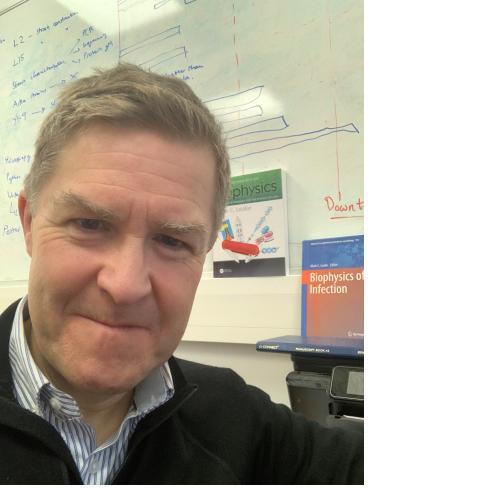
| Affiliation | Telephone |
|---|---|
| Professor in the Department of Physics | |
| BSI Director / Chair of Natural Philosop in the Department of Biosciences |
Biography
Professor Mark C. Leake BSI Director and Chair of Natural Philosophy
Affiliation
Director of the Biophysical Sciences Institute
Chair of Natural Philosophy
Professor in the Department of Biosciences
Professor in the Department of Physics
Professor Mark Leake is an interdisciplinary biophysicist working at the interface of physics, biology and engineering. He joined Durham University in October 2026 as Director of the Biophysical Sciences Institute and Chair of Natural Philosophy.
Following his undergraduate study as a physics-flavoured Cambridge ‘natsci’, he gained his PhD in 2001 in Biophysics at the Randall Institute, King’s College London under the supervision of Bob Simmons FRS developing novel optical tweezers methods to probe the giant muscle protein titin. This was followed by postdoctoral postings in Heidelberg University, including secondment at Colombia, US focusing on creating innovative AFM force spectroscopy tools with Julio Fernandez, and then with Richard Berry and Judy Armitage FRS developing new TIRF microscopy methods to study bacteriual chemical and motion at the University of Oxford. Professor Leake established his independent research career in 2005 at the University of Oxford supported by a range of prestigious fellowships from the Leverhulme Trust, Hertford College Oxford, the Oxford Integrative Centre for Systems Biology and as a Royal Society University Research Fellow, culminating in the invention of a novel optical microscopy technology called Slimfield which enable tracking of single biomolecules in live cells at rapid millisecond sampling rates, which he applied in groundbreaking studies to unpick the molecular components of DNA replication and recombination in bacteria.
In 2013 he was recruited by the University of York and became its inaugural Anniversary Chair of Biological Physics, supported by research fellowships from the Leverhulme Trust and Royal Academy of Engineering. He drove several senior academic leadership roles whilst at York including being the University’s Research Champion for Technologies for the Future and also founding and directing the Biological Physical Sciences Institute, an exceptional interdisciplinary collective comprising over 200 cross-departmental researchers, and was the inaugural Coordinator of the University of York’s Physics of Life Group, a cross-disciplinary major research division comprising ~10 different research teams.
Professor Leake has recently been the Chair of the Biological Physics Group of the Institute of Physics (IoP), and since 2022 has been the Chair of the UKRI-funded Physics of Life Network (PoLNET), a national collective of over 2,000 research scientists supporting transformative collaboration across the physical and life sciences. In this capacity he oversaw the development of a UKRI-commissioned national Roadmap for Physics of Life, setting out strategic opportunities and priorities for the field over a timescale of the next 25 years. He is passionate about supporting the next generation of researchers at the interface between the physics and life sciences, and in 2023 brokered with UKRI the establishment of an entirely new funding scheme enabling postdoctoral researchers in Physics of Life to apply for and lead their own research grants.
He is dedicated to broadening participation and increasing diversity across biology, biophysics and Physics of Life. During his Chairship, the IoP Biological Physics Group grew to become both the largest of the Institute’s specialist groups by membership and the group with the highest proportion of female members. He also serves on executive committees of the Royal Microscopical Society and the British Biophysical Society.
His research and leadership have attracted more than £20 million in funding, including a prestigious EPSRC advanced career Open Fellowship. His distinctions include the 2010 British Biophysical Society Medal and Prize, awarded to the most promising early-career researcher in Britain and Ireland, the Institute of Physics Rosalind Franklin Medal (joint award) in 2020, and fellowships of the Institute of Physics, Royal Microscopical Society and Royal Society of Biology.
His research develops and applies quantitative single-molecule approaches to understand how molecular interactions and collective assemblies generate biological function in living cells, and has led to over 150 research articles, over 30 of which have each been cited in excess of 100 times, culminating in over 10,000 cumulative citations.
Research Interests
The Leake group combines single-molecule fluorescence microscopy, super-resolution imaging, molecular biophysics, quantitative genetics, advanced image analysis and physical modelling. Its overarching aim is to connect the nanoscale dynamics of biomolecules to mesoscale organisation, cellular physiology and adaptation.
Biomolecular condensates and cellular organisation
How proteins and RNA assemble into dynamic, membrane-less compartments; how molecular composition determines material properties, exchange and biological function; how bacterial aggresomes contribute to stress responses and antibiotic tolerance; and how biomolecular condensates can be re-engineered for synthetic exploitation including therapeutics.
Single-molecule biophysics and biophotonics
Development of innovative rapid and high-sensitivity optical imaging, single-particle tracking bespoke analysis, molecular counting and correlative approaches to resolve biomolecular behaviour in living cells.
Molecular machines and genome regulation
Quantitative investigations of DNA replication and repair, transcription, chromatin organisation, membrane-associated machinery and bacterial motility.
Molecular mechanics and topology
Investigating the links between biomolecular mechanics and topology in DNA, RNA and filamentous proteins; and the emergence of topological complexity and resolution of topological barriers in DNA.
Physics of Life and interdisciplinary science
Integration of experiment, computation and theory to identify general physical principles in living systems, and creation of research networks connecting physicists, biologists, chemists and engineers.
Leadership
Director, Biophysical Sciences Institute, Durham University (from 2026).
Chair, UK Physics of Life Network PoLNET (from 2022)
Oversaw the UKRI-commissioned national Roadmap for Physics of Life (2025-2026).
Brokered a new UKRI Physics of Life postdoctoral research grant scheme enabling postdoctoral researchers to apply as independent grant.
Former Chair, IOP Biological Physics Group; during this period the group became the IOP’s largest specialist group and had its highest proportion of female members.
Executive committee member, Royal Microscopical Society and British Biophysical Society.
Principal Investigator, EPSRC Open Fellowship on the biophysics of mesoscale, reversible biomolecular assemblies EP/Y000501/1 (from 2024).
University Research Champion for Technologies for the Future (2021-2022).
Director of the Biological Physical Sciences Institute, University of York (2013-2026).
Leader of multiple national and international interdisciplinary research and training initiatives spanning the physical–life sciences interface.
Teaching and supervision
Professor Leake supervises interdisciplinary doctoral and postdoctoral researchers and contributes to training in biological physics, quantitative microscopy and single-molecule methods. He is the author of research-led textbooks aimed at connecting the physical sciences with modern biology.
Selected publications
· Betts, J. K. et al. (2026). A protein-dependent riboswitch activates ribosomal frameshifting in cardioviruses. Molecular Cell 86, 3545-3564. https://doi.org/10.1016/j.molcel.2026.07.036
· Howard, J. et al. The transitional kinetics between open and closed Rep structures can be tuned by salt via two intermediate states. Nucleic Acids Research 54:gkaf1483. (2026). https://doi.org/10.1093/nar/gkaf1483
· Pei, L., Xian, Y., Yan, X., Schaefer, C., Syeda, A. H., Howard, J. A. L., et al. (2025). Aggresomes protect mRNA under stress in Escherichia coli. Nature Microbiology 10, 2323–2337. https://doi.org/10.1038/s41564-025-02086-5
· Payne-Dwyer, A. et al (2025) SlimVar for rapid in vivo single-molecule tracking of chromatin regulators in plants. Nature Communications 16, 815 https://doi.org/10.1038/s41467-025-63108-8
· Leake, M. C. (2025). Single-molecule biophysics. Contemporary Physics 65(4), 259–287. https://doi.org/10.1080/00107514.2025.2556579
· Barrett, J. et al. A promiscuous mechanism to phase separate eukaryotic carbon fixation in the green lineage. (2024). Nature Plants. 10, 1801-1913. https://doi.org/10.1038/s41477-024-01812-x
· Payne-Dwyer, A. et al. (2024). Predicting Rubisco-Linker Condensation from Titration in the Dilute Phase. Physical Review Letters 132, 218401. https://doi.org/10.1103/physrevlett.132.218401
· Shepherd, J. et al (2024). Correlating fluorescence microscopy, optical and magnetic tweezers to study single chiral biopolymers, tested on DNA plectoneme formation dynamics. Nature Communications (2024) 15, 2748. https://doi.org/10.1038/s41467-024-47126-6
· Fosado, Y. A. G. et al. (2023). Fluidification of entanglements by a DNA bending protein. Physical Review Letters 30, 058203. https://doi.org/10.1103/physrevlett.130.058203
· Leake, M. C. (2022) Surviving early career research and beyond in biophysics/biological physics: A concise user guide. Physical Biology 19(5). https://doi.org/10.1088/1478-3975/ac7373
· Jin, X. et al. (2021) Membraneless organelles formed by liquid-liquid phase separation increase bacterial fitness. Science Advances (2021) 7, eabh2929. https://doi.org/10.1126/sciadv.abh2929
· Cosgrove, J., et al. (2020). B cell Zone Reticular Cell Microenvironments Shape CXCL13 Gradient Formation. Nature Communications. 11, 3677. https://doi.org/10.1038/s41467-020-17135-2
· Pu, Y. et al. (2019). ATP-dependent dynamic protein aggregation regulates bacterial dormancy depth critical for antibiotic tolerance. Molecular Cell 7:143-156. https://doi.org/10.1016/j.molcel.2018.10.022
· Miller, H. et al. (2018) Single-molecule techniques in biophysics: a review of the progress in methods and applications. Reports on Progress in Physics. 81(2), 024601. https://doi.org/10.1088/1361-6633/aa8a02
· Wollman A. J., et al. (2017) Transcription factor clusters regulate genes in eukaryotic cells. Elife. (2017) 6, e27451. https://doi.org/10.7554/elife.27451
· Badrinarayanan, A. et al. (2012) In vivo architecture and action of bacterial structural maintenance of chromosome proteins. Science 338, 528-531. https://doi.org/10.1126/science.1227126
· Reyes-Lamothe, R. et al. Stoichiometry and architecture of active DNA replication machinery in Escherichia coli. (2010) Science 328, 498-501. https://doi.org/10.1126/science.1185757
· Plank M. et al. (2009). Millisecond timescale slimfield imaging and automated quantification of single fluorescent protein molecules for use in probing complex biological processes. Integrative Biology 1, 602 – 612. https://doi.org/10.1039/b907837a
· Leake, M. C. et al. (2006). Stoichiometry and turnover in single, functioning membrane protein complexes. Nature. 443, 355-8. https://doi.org/10.1038/nature05135
Books and edited volumes
· Leake, M. C. Single-Molecule Cellular Biophysics, (2013) Cambridge University Press. https://doi.org/10.1017/CBO9780511794421
· Leake, M. C. Biophysics of Infection, (2016) Spinger Nature. https://doi.org/10.1007/978-3-319-32189-9
· Leake, M. C. Biophysics: Tools and Techniques, (2016) CRC Press. ISBN-13: 978-1498702430
· Leake, M. C. Biophysics: Chromosome Architecture, (2022) Humana Press/Springer. https://doi.org/10.1007/978-1-0716-2221-6
Leake, M. C. Biophysics: Tools and Techniques for the Physics of Life, (2023) Taylor and Francis. https://doi.org/10.1201/9781003336433

Esteem Indicators
- 2026: Director, Biophysical Sciences Institute, Durham University :
- 2025 - 2026: Brokered a new UKRI Physics of Life postdoctoral research grant scheme enabling postdoctoral researchers to apply as independent grant.:
- 2024 - 2030: Principal Investigator, EPSRC Open Fellowship on the biophysics of mesoscale, reversible biomolecular assemblies EP/Y000501/1 :
- 2022: Chair, UK Physics of Life Network PoLNET :
- 2021 - 2025: Chair, IOP Biological Physics Group; during this period the group became the IOP’s largest specialist group and had its highest proportion of female members.:
- 2021 - 2022: University Research Champion for Technologies for the Future, University of York:
- 2020: Co-Recipient of the Institute of Physics Rosalind Franklin Medal and Prize for exceptional work of the Physics of Life network national community engagement:
- 2018: Executive committee member, Royal Microscopical Society and British Biophysical Society.:
- 2013 - 2026: Director of the Biological Physical Sciences Institute, University of York:
- 2010: British Biophysical Society Early Career Award for the most promising biophysics researcher in the UK and Ireland:
- 2005: Leader of multiple national and international interdisciplinary research and training initiatives spanning the physical–life sciences interface.: