

/filters:quality(70)/prod01/prodbucket01/media/durham-university/alumni-/the-hub/The-Hub-Banner.png)
My Durham Story - By James Hua
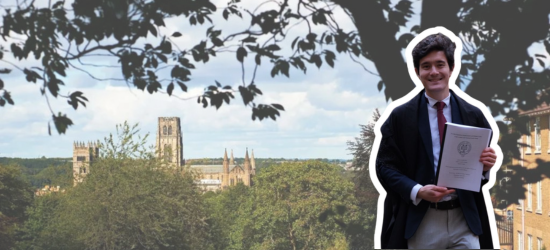
By: James Hua Class of: 2020 College: St Cuthbert's Society Subject: Classics Location: Athens
Job title: Postdoctoral Student in Ancient History/Epigraphy at the British School at Athens Organisation name: British School at Athen

Why did you choose to study at Durham?:
The diversity, forward-looking, and innovative outlook of the courses and modules taught in the Classics Department at Durham: rather than simply teaching old history and standard texts, the power for professors to choose interesting topics for modules and share their own cutting-edge research with us was really appealing and mind-opening. In addition, the warm environment and tight-knit community of the Classics Department at Durham, which I read about on the website and experienced throughout, and the vibrant Classics Society and its journal Ostraka, were great stimuli as well. And Durham is a lovely scenic town as well!
What was it like to be a student at Durham? Tell us about college life, the city, your course and any sports or societies you were involved in.:
It was excellent! I mainly stayed in the Classics Department during my degree and formed my academic and social friend circles there, rather than in College or the main city. The Department was such a wonderfully welcoming, open, and intellectually vibrant place - the library was well-equipped (and pleasantly warm!), while the ability to visit lecturers during their office hours, and meet them and always learn more during research seminars, was really formative for my academic development today. It would be remiss to leave out the Durham Classics Society, which also played a fundamental role in my time there - both in academic event, social events, and of course its wonderful journal Ostraka. Finally, there were also a surprising number of ancient Greek/Roman museums, sites, and monuments to visit around the town - Penshaw monument was always a highlight! My accommodation in St Cuthbert's Society was excellent too.
What are your fondest memories of your time here?:
Talking with professors after their lectures, and after research seminars during receptions, were truly memorable. Many of these conversations both made me feel welcome and included in both the discipline and Department, and also gave me many research ideas which I eventually developed in my PhD and beyond. The lecturers really dedicated much time in their lectures and went above and beyond expectations in aiding us students to understand the topic and excel - and their efforts are visible in my current development now (among others Classics students too). I am really grateful to them, and thoroughly recommend the Classics Department's efforts and academic discipline in particular.
What have you been up to since you left Durham?:
I pursued a Masters of Philosophy in Ancient History in Oxford (2020-2022), a PhD / DPhil in Ancient Greek History in Oxford as well, on a topic which my undergraduate dissertation supervisor (Prof Polly Low) inspired me on. I submitted my thesis this past December (2025), and have now started a postdoctoral position at the British School at Athens, the main research institute for Ancient and Modern Greek culture in Greece (2026). I still credit much of my development to my happy years in Durham!
How has Durham inspired you to get where you are today? Tell us about any career highlights and achievements.*:
Yes, in more ways than I could have imagined. As I mention above, my thesis topic was propelled by conversations with and advice from my undergraduate dissertation supervisor. My work ethic of always trying my hardest and helping others, alongside the key skills needed in Classics and Ancient History, were developed here. And finally, my ability to organise events and publish academic articles is largely thanks to my time in the Classics Faculty with Ostraka and during the degree! A true highlight...
What would be your top piece of advice for anyone considering studying at Durham?:
Definitely make the most of what the Departments and Student Societies have to offer, and don't be afraid to introduce yourself and meet people! Explore new ideas in essays, your undergraduate years (and especially the welcoming and forward looking Classics Department) are the time to explore your capacities and flourish, and the Lecturers will really put a lot of effort into helping you. The experience will be truly rewarding!
Why is staying connected to your alumni community important to you? Tell us about anything you have gained from your alumni engagement with Durham.:
I have various friends whom I enjoy keeping in touch with, and many are still in my academic field! The bonds formed are lifelong.
Any published work?:
https://oxford.academia.edu/JamesHua Published (by date) 1. Rassios, A.E., Krikeli, A., Dilek, Y., Ghikas, C., Batsi, A., Koutsovitis, P., Hua, J. (2022), ‘The Geoheritage of Mount Olympus: Ancient Mythology and Modern Geology’, Geoheritage 14:15. 2. Chaniotis, A., Corsten, T., Papazarkadas, N., Stavrianopoulou, E., Zellmann-Rohrer, M., Carbon, J.-M. Kantor, G., Sverkos, E., Hallmannsecker, M., Hua, J. et al. (2022), Supplementum Epigraphicum Graecum, Volume LXVII. Leiden. 3. Carbon, J.-M., Chaniotis, A., Corsten, T., Papazarkadas, N., Stavrianopoulou, E., Zellmann-Rohrer, M., Kantor, G., Paschidis, P., Sverkos, E., Hallmannsecker, M., Hua, J. et al. (2023), Supplementum Epigraphicum Graecum, Volume LXVIII. Leiden. 4. Carbon, J.-M., Chaniotis, A., Corsten, T., Papazarkadas, N., Paschidis, P., Stavrianopoulou, E., Zellmann-Rohrer, M., Sverkos, E., Hofmann, V., Hua, J. et al. (2024), Supplementum Epigraphicum Graecum, Volume LXIX. Leiden. 5. Hua, J. (2025), “IG II3 4 1212: Dedication to Hera” and “IG II3 4 1213: Dedication to Hera Bounaia”. Attic Inscriptions Online. Published 5 May 2025. https://www.atticinscriptions.com/inscription/IGII34/1212. 6. Hua, J. (2025), “IG IV2 792-804: Boundary markers of agricultural estates on Aigina”. Attic Inscriptions Online (18 entries). Published 19 August 2025. https://www.atticinscriptions.com/inscription/IGIV2/803. Submitted (in press) 1. Hua, J. (2026), ‘Between ‘evacuation’ and ‘being kicked out’: mapping the ancient terminology of population expulsions onto lived experience in Classical Greece’, in S. F. Adali, B. Gray, E. Isayev, E. Jewell, T. Kaçar, L. A. Mazurek, J. Mokrišová (eds.), Mobility in Antiquity: Rethinking the Ancient World through Movement. London. 2. Hua, J. (2026), ‘Exiled populations in the public epigraphy and life of Classical Athens: the case of the Plataians’, in J. Edmondson, J. Sickinger, and G. Tsolakis (eds.), Epigraphy and Civic Life in the Graeco-Roman World: Fourth North American Congress of Greek and Latin Epigraphy (NACGLE IV). Leiden. 3. Hua, J. (2026), ‘Attitudes and empathy towards displaced populations in Classical Athenian Oratory’, in R. Hatzilambrou and G. Carla (eds.), Speaking of the Weak: The Rhetoric of Vulnerability in Greek Oratorical Texts. Trends in Classics Series. Berlin. 4. Carbon, J.-M., Chaniotis, A., Corsten, T., Papazarkadas, N., Paschidis, P., Stavrianopoulou, E., Zellmann-Rohrer, M., Sverkos, E., Hofmann, V., Hua, J. et al. (2026), Supplementum Epigraphicum Graecum, Vol. LXX. Leiden. Website or blog link?: https://www.classics.ox.ac.uk/people/james-hua