/filters:quality(70)/prod01/prodbucket01/media/durham-university/colleges/college-of-st-hild-amp-st-bede/location-images/04E9EFC9-15A7-41D3-ADF5-19AAAD386967.jpg)
The Caedmon Ceolfrid Trust
Introduction
As one of the oldest Colleges in Durham, Hild Bede benefits from a long history and large community of alumni, friends and supporters.
Many members of community are benefactors. Some give in terms of a contribution to mentoring, or career development and advice to current students, through speaking and networking in formal and informal ways. Others champion us in the wider world and that they are part of us is a matter of pride and cause of celebration to us. Over the years many have and do donate to support student welfare, chaplaincy, music and the arts, sports and scholarships in a wide variety of subjects and disciplines. They have also donated funds to support student development in areas that students themselves tell us will help now and in terms of their future development and success.
The Caedmon Coelfrid Trust is proud to be supported by our College alumni community

The College and Trust Crest
The History of the Trust
The Caedmon Ceofrid Trust is one of our most important and highly valued means of support to students associated with our College. The Trust was established in 1982 by College Alumni who wanted to enhance the experience of students during their time in College. It is a registered charity No. 702209, founded for the benefit of The College of St Hild & St Bede, Durham, DH1 1SZ). It is served by a Board which the comprises the current SRC President, alumni and is supported by a secretary and treasurer. The Board is chaired by the College Principal.
The Trust takes its name from two Northern Saints, Caedmon and Ceolfrid. Caedmon was Britain’s first poet and a hymn writer nurtured by St Hild, and Ceolfrid was a friend and warden of St Bede. Caedmon and Ceolfrid reflect the joining and coming together of the Colleges of St and St Bede in the formation of Hild Bede and also the nurturant role of the Trust towards members of this community.
The Purpose of the Trust
The Trust’s objectives are to promote educational and personal development of students at the College of St Hild & St Bede, Durham University, by making and awarding grants in such ways as the charity trustees think fit, including by:
(a) Making and awarding grants to students support the educational and developmental activities of individuals and groups including but not limited to: academic, sporting, performing and musical and which are not generally eligible for support through other means within the University.
(b) Making and awarding of grants, sought via application to the by the board, which demonstrably enrich the educational and developmental life and experience of the College to the benefit of all student members.
Students are defined as current members of the Student Representative Council (SRC) of the College of St Hild and St Bede, Durham University.
The Trust Board meets once a term and receives and considers applications from students at each of these meetings. The Trust makes students aware of the application rounds through the College newsletter and other communications.
The Trust can support students in hardship, certain extra-curricular activities and postgraduate research, and has historically funded the marquee at College Day. It also usually provides up to eight annual Choral Scholarships. As well as supporting individuals, the Trust also supports Clubs and Societies.
Trust impact and benefit
The Trust has helped hundreds of students over its nearly forty years of work. In recent years it has supported students who have wanted to learn a new language in order to undertake volunteering refugees, funded training to become a sports coach in order to work with young people, sent students to conferences allied to their studies, paid for work wear and participation in seminars, events, concerts and competitions.
The Trust has made loans to some of our clubs and societies – especially where they have faced large capital outlays which it would it be difficult for them to meet in year. The Boat Club and Theatre have benefited from this support.
The Trust provides a number of choral scholarships each year which recognise the brilliance of our College Chapel Choir and help to maintain it as one of the best and most accessible in Durham and any College anywhere.
It has helped where hardship hits students and where even a small sum can make the difference between being able to try out something or to do something rather than not.
The Trust has supports out alumni engagement work enabling students to be network directly with alumni in support of their development, experience and even careers.
Often times, students agree to share the experiences and the impact of work that the Trust has supported with others beyond the Board. For instance, by writing for the Magazine of the College Alumni Association. In due course, we want to see those stories here for you to read too.
Applications and eligibility
Students are invited to apply to the Trust for support every term. College manages the process and sends notifications about the deadlines for applications and supports the preparation of submission with advice where required. Any member of the SRC is eligible to apply. The Board review all eligible applications and make a decision on whether to make an award which may be in part or total. The Board looks closely at applications in terms of the objectives set out above. If a student applies, they need to be able to show how the request meets their development needs; that it would be difficult to find support from another source; and, benefit or enrich the wider College community.
The Board may ask an applicant for more information or refer an applicant to an alternative fund if the application seems to be better suited to that.
Supporting the Trust
Hild Bede students flourish because the Trust thrives. The Trust thrives because of the support it receives from friends of College and especially our alumni. We have been extremely lucky and are very grateful to those who have and do give. Perhaps you would like to join us?
The Board welcomes donations of any size, at any time, to enable it to make more of a difference to more students. If you would like to donate including setting up to be a regular giver please do get in touch at hildbede.alumni@durham.ac.uk
Doing Ethnographical Fieldwork in Vietnam: The Operation and Impact of Shrimp Farming in the Mekong Delta
I studied for my doctoral degree in Human Geography at Durham University from October 2018 to September 2022. My doctoral research examines how water, land use, labour and multiple species are governed under conditions of climate change by studying shrimp economies of the Mekong Delta. My doctoral study was supported by the Caedmon/Ceolfird Trust and John Simpson Greenwell memorial fund from the College of St Hild & St Bede. I was able to spend 12 months ethnographical fieldwork in Vietnam and share my results at international conferences with scholars from various disciplines.
Due to climate change and saline water intrusion, the Mekong Delta has become one of the most vulnerable sites. In the last few years, farmers have faced serious drought and land salinisation. To tackle this challenge, the Vietnamese government encouraged farmers in the coastal region to shift from growing rice to breeding shrimp as a strategy for climate change adaptation and poverty alleviation. Shrimp farming as an export-oriented industry also fits well with the Vietnamese policy after Đổi Mới (market reforms) in 1986. My doctoral research explored two fundamental questions: How does shrimp farming take shape in the Mekong Delta? How does shrimp farming influence the everyday life of farmers and capitalists?
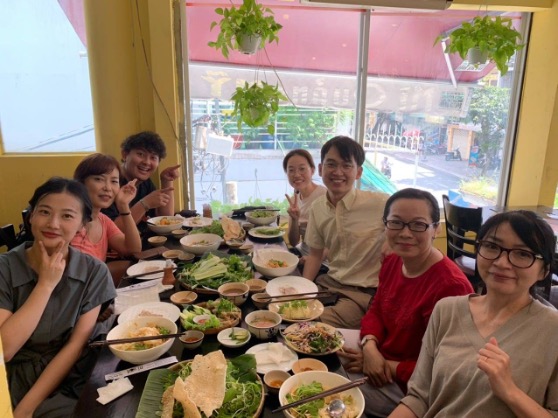
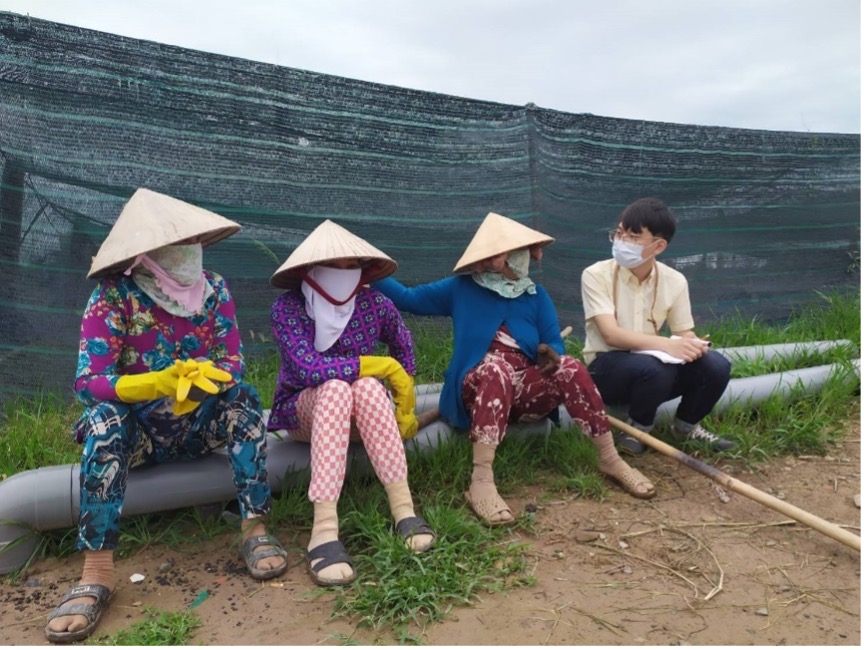
To answer these research questions, I have conducted my fieldwork by visiting farmers, capitalists, governmental sectors, and an international NGO (48 informants) in the hatchery, the shrimp farm, and the lab within and beyond the Mekong Delta (Figure 2). I practised participatory observation with Vietnamese farmers, a Taiwanese shrimp company and a shrimp diseases laboratory. It is crucial to understand how these three sites are held together to underpin the formation and operation of the shrimp industry. The hatchery reproduces larvae for farmers. Shrimp then are grown into marketable sizes by farmers, workers, and capitalists. The lab provided testing services and biotechnology commodities to hatcheries and shrimp growers to prevent shrimp diseases.
From September 2019 to October 2020, I learned to speak Vietnamese and independently conducted my fieldwork in Vietnam. Learning a new language and doing fieldwork at the same time was not an easy task. I went to university every weekday for 4 hours and conducted my research in the afternoons. At the beginning of my field trip, I was unsure whether I could collect enough data due to the language barrier. With the generosity of the College grant, I was able to learn Vietnamese for nine months and received a C1 level (native speaker level) certificate from a Vietnamese language exam.
However, it was challenging for me as a foreign researcher to conduct fieldwork in Vietnam, an authoritarian country, during the pandemic for two reasons. One reason is that foreign researchers need to apply for a research permit from the local government three weeks ahead. Researchers need to coordinate the time frame of bureaucratic procedures and fieldwork trips. Fortunately, I have managed the farming schedule and the timetable of research permits issued by local governments to observe how farmers harvested shrimp. The other reason is that the pandemic interrupted field trips to the Mekong Delta. Thus, I developed a flexible research plan to tackle the uncertainty. Instead of staying in the village all the time, I worked in a shrimp diseases laboratory to see how scientists analyse shrimp pathology and help shrimp feed companies to design their products.
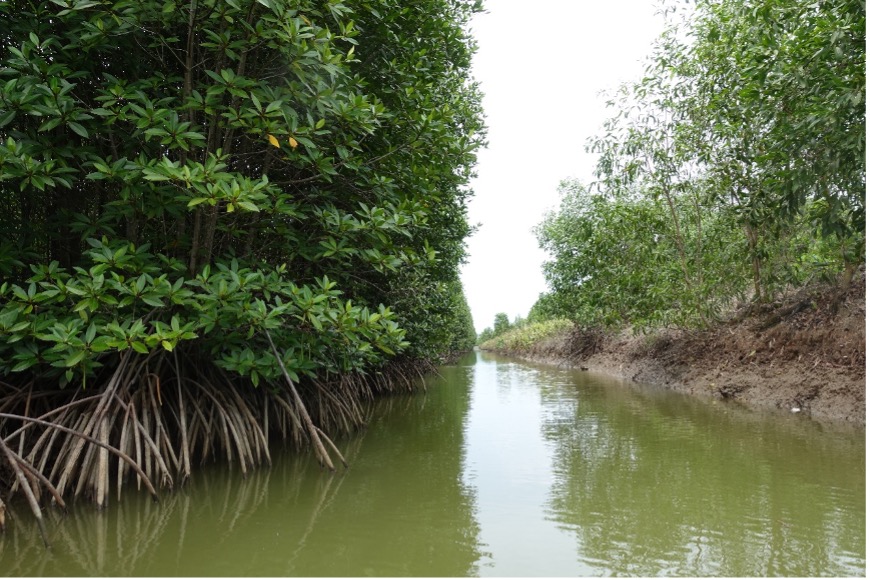
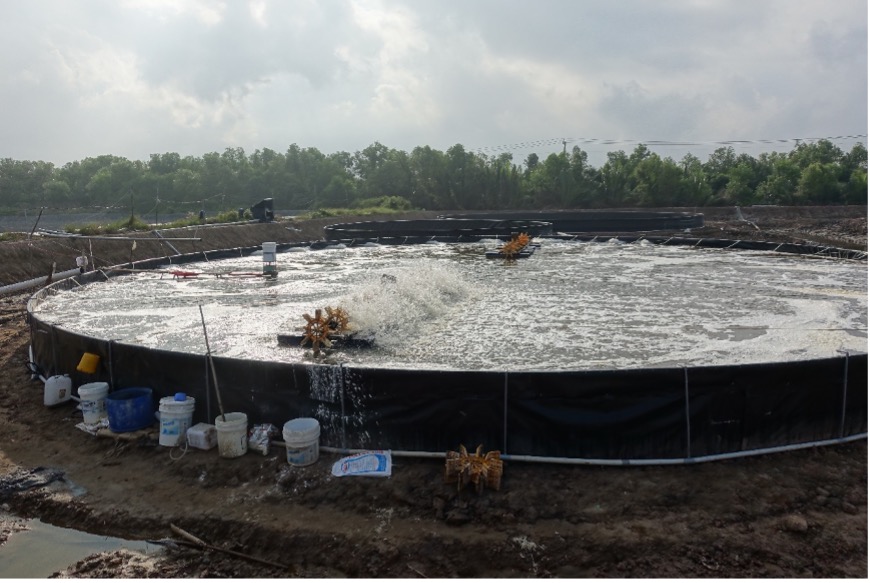
My doctoral thesis argued that shrimp farming is formed and constructed by organising water-shrimp-humans-environment relations across the hatchery, the shrimp farm, and the lab. The hatchery can industrialise shrimp reproduction by unpacking the life cycle of shrimp, domesticating shrimp, algae, and brine shrimp, and developing artificial shrimp feed. The hatchery and its supporting industry facilitate the development of shrimp farming in the Mekong Delta. On shrimp farms, farmers and capitalists adopt four kinds of shrimp farming, integrated mangrove-shrimp farming, improved extensive shrimp farming, intensive shrimp farming, and super-intensive shrimp farming, to manage water-shrimp-humans-environment relations for capital accumulation and disease control (Figure 3 & 4). The first two kinds of shrimp farming have lower shrimp production and disease risks, while they highly rely on daily and seasonal changes of water quality and quantity. By contrast, the two kinds of intensive shrimp farming mobilise devices and infrastructure to overcome natural barriers, increase shrimp production, and improve biosecurity practices. However, intensive shrimp farming has a higher risk of shrimp disease, which causes some farmers exposed to a higher risk of being indebted. Therefore, the laboratory plays a crucial role in providing biosecurity knowledge and biotechnology commodities to prevent shrimp diseases in the field and shape the operation of the shrimp industry.
During my doctoral study, I built up my academic networks with Vietnamese scholars and other international researchers. While in Vietnam, I was affiliated with the Centre of Water Management and Climate Change. With their kind helps, I was allowed to research the countryside. I also learned about fieldwork experiences from the Saigon Social Sciences Hub (SSSH), which was organised by European and Asian PhD candidates in History, Geography, Sociology, and Anthropology. After returning from my field trip to the UK, I was funded by the Caedmon/Ceolfird Trust to present my research findings at the Royal Geographical Society and the Association of American Geographers. I was also invited to present my research at the Global South Studies Centre, University of Cologne and the Department of Sociology, National Sun-Yat Sen University. Attending workshops and conferences allowed me to disseminate my research to broader audiences in anthropology, sociology, and developmental studies.
I am grateful for the generous support from the College of St Hild & St Bede during my doctoral study. Learning Vietnamese and conducting fieldwork in the Mekong Delta are valuable experiences for my future academic career in Geography and Vietnamese studies.