

/filters:quality(70)/prod01/prodbucket01/media/durham-university/departments-/faculty-of-science-/general-pictures/71353.jpg)
Novel house design cuts childhood malaria significantly
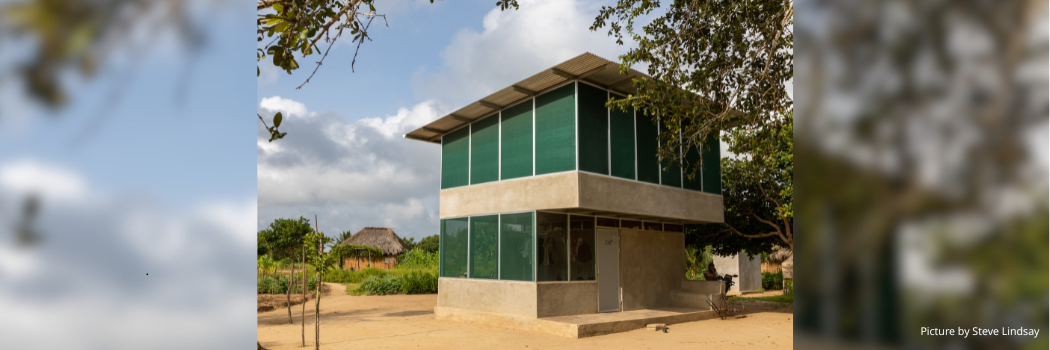
A major study involving Durham University shows that a radical rethink of rural housing design in sub-Saharan Africa can protect children from the three deadliest childhood diseases.
The three-year trial in Tanzania found that children living in specially designed two-storey “Star Homes” had dramatically lower rates of malaria, diarrhoea, and acute respiratory infections compared with children in traditional mud-and-thatch houses.
The children in the Star Homes also grew taller as a result of their better health.
Protecting children
Malaria, diarrhoea and acute respiratory infections are three major causes of mortality in young children in sub-Saharan Africa. In the trial, malaria was reduced by 44%, diarrhoea by 30% and respiratory infections by 18%.
The researchers are calling on architects, builders, and governments to think differently about rural house design to help protect children from disease.
The Star Home is the outcome of almost 40 years of research involving Professor Steve Lindsay from Durham. The healthy house design was informed by his research on how mosquitoes enter homes, and multiple clinical trials of house-screening in traditional African houses.
It has resulted in the Star Home that not only protects children from killer diseases but is also cheaper to build using less carbon than conventional concrete African houses.
Our ground-breaking study shows that building better can turn a dangerous home into a safe one by protecting children in sub-Saharan Africa against three major killer diseases - malaria, diarrhoea and respiratory infections.
Healthy home
The Star Home costs 24% less in materials than a conventional single-storey cement-block house, requires 73% less concrete, and generates 57% less embodied carbon.
It is a two-storey prefabricated structure with the following key features:
- Shade-net walls that let in air, keeping sleeping areas cool and deterring mosquitoes
- Screened windows and self-closing doors to reduce insect entry
- Elevated easy-to-clean concrete ground floor
- Rainwater harvesting system providing safe drinking water
- Fly-proof ventilated pit toilet
- Improved cooking stove that vents smoke outdoors
- Solar-powered lighting
The Star Homes use passive cooling rather than air conditioning which requires energy that is neither available nor affordable. After sunset, the upstairs space with the bedrooms cools down rapidly making it more comfortable for families to use bed nets for additional protection against mosquitoes.
We now hope that the building industry will adopt some of the important features of our healthy house design that are protective, cheaper and use less carbon than conventional concrete African houses.
Find out more
- The research was conducted by an international consortium including: CSK Research Solutions (Tanzania), Mahidol-Oxford Tropical Medicine Research Unit (MORU) at the University of Oxford, Royal Danish Academy, Ifakara Health Institute (Tanzania), Durham University (UK), Amsterdam UMC (The Netherlands), University of the Philippines and East, Central and Southern Africa Health Community. It was funded by Hanako Foundation, Singapore.
- You can read the research paper in Nature Medicine.
- Find out more about Steve Lindsay’s research.
- Our Department of Biosciences is ranked third in the UK in the Complete University Guide 2026. Visit our Biosciences webpages for more information on our undergraduate and postgraduate programmes.