

/filters:quality(70)/prod01/prodbucket01/media/durham-university/study/doctoral-school/Slim-banner-Doctoral-School.png)
Developing engagement and impact skills
If you are considering a career outside academia, the skills you gain from a PhD (independent project management, complex analysis, writing, resilience) are more transferable than they can feel from inside a thesis. The Careers Service runs sessions specifically on translating research experience for non-academic employers; it's worth attending even if you think you want to stay in academia, since plans often change.
See real examples of the range of paths Durham doctoral researchers take: Doctoral Alumni Stories
Engagement and broadcast opportunities

A research degree can also open the door to public-facing work, broadcasting, journalism, and public commentary, for researchers who want to communicate their subject beyond academia. A few examples are provided here, but please check with your department for other opportunities or (if you are a funded student) your funder.
Three Minute Thesis (3MT)
Durham takes part in 3MT, the international competition (originally developed by the University of Queensland) that challenges doctoral researchers to present their research and its significance to a non-specialist audience in just three minutes, with a single slide.
This is a great exercise in distilling your research to its essentials, and Durham's finalists go on to represent the university at the Matariki Network's international 3MT final. Law School PhD researcher Miranda Wang won the 2025 Matariki 3MT competition with her presentation on mind-reading neurotechnology and criminal justice, competing against entrants from across the Matariki Network's member universities worldwide.
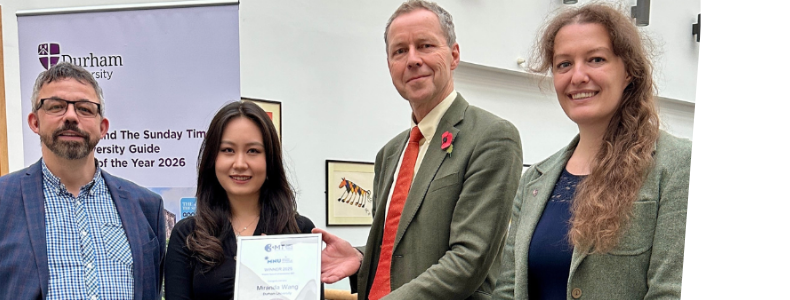
Current students can find out more, and watch past winning entries, via DCAD’s SharePoint pages.
New Generation Thinkers
The AHRC and BBC New Generation Thinkers scheme, predominantly for researchers in the Arts & Humanities and some Social Science disciplines, has run annually since 2010. It selects a small cohort of early-career researchers (currently five a year) to work directly with BBC Radio 4 programme makers, shadow the production process, and appear on air, alongside dedicated training in media engagement, public communication, and working with policymakers. Applications are run through UKRI and are open to current PhD researchers who have made considerable progress on their research (broadly within a year of submission), as well as early career academics within eight years of their PhD award.
Full eligibility and the current application round: AHRC and BBC New Generation Thinkers – UKRI
Science engagement
Within the Faculty of Science, the Science Engagement team lead and co-ordinate a wide range of outreach and engagement programmes. These include working with local schools, community projects and initiatives, and partnerships with several internal and external organisations, such as Durham County Council, STEM Learning, Space Camp UK, the National Co-Ordinating Centre for Public Engagement, and The Ogden Trust.
The team works with various Centres for Doctoral Training at Durham, providing specialist training and on-going mentoring support for postgraduate students in aspects of science outreach and engagement, including ethos, ethics, communication skills, delivery and evaluation strategies.
Expert opinion pieces
Many researchers build a public profile more gradually, for example by writing for outlets like The Conversation (which specialises in publishing academic expertise for a general audience), commenting for local or specialist press, or starting a podcast or blog around their research.
Durham's Communications team can advise on and help facilitate media opportunities and requests for researchers wanting to build this side of their work, including training for current staff and research students on how to write expert comment pieces for The Conversation and other media outlets.
Have a suggestion for this page, or a resource that's helped your own career planning, or want to share your success? Let the Doctoral School know so we can keep it useful for future researchers. doctoralschool.enquiries@durham.ac.uk